
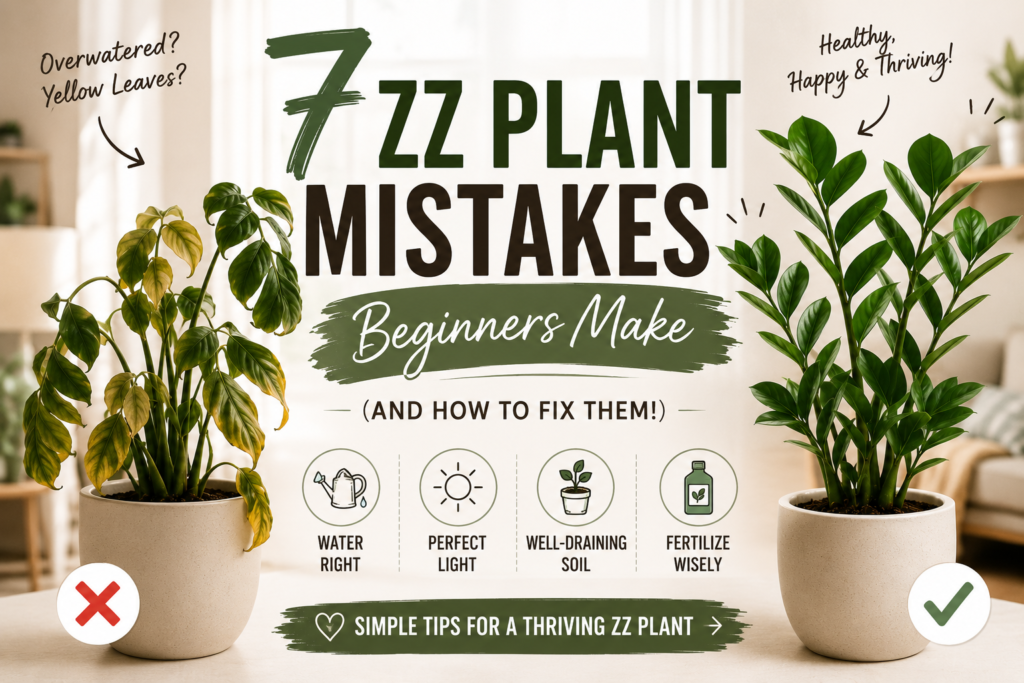
Introduction: Why Your “Low Maintenance” ZZ Plant Is Struggling
The ZZ plant (Zamioculcas zamiifolia) is one of the most popular indoor low light plants in the United States.
It’s recommended for:
- Small apartments
- Busy professionals
- Renters
- First-time plant owners
- Low-light homes
You’ll often hear it described as:
“Unkillable.”
But here’s what no one tells beginners:
ZZ plants don’t die from neglect.
They die from incorrect care.
Especially in US homes with:
- Central heating
- Air conditioning
- Low winter humidity
- Decorative pots without drainage
If you’re searching for:
- How often to water ZZ plant
- Why is my ZZ plant turning yellow
- ZZ plant overwatering signs
- ZZ plant care for beginners
This complete beginner guide will help you fix the root problems — literally.
Mistake #1: Overwatering (The #1 ZZ Plant Killer)
If you fix only ONE mistake from this article, fix this one.
Why ZZ Plant Overwatering Happens
Beginner mindset:
“It’s a tropical plant. It must need frequent watering.”
Reality:
ZZ plants store water in thick underground rhizomes (bulb-like roots). These act as natural reservoirs.
They are built to survive drought.
They are not built to sit in wet soil.
Signs of ZZ Plant Overwatering
- Yellow leaves (especially bottom leaves)
- Soft or mushy stems
- Soil that stays wet for over a week
- Foul smell from pot
- Black, slimy roots (advanced root rot)
If caught early, recovery is possible.
If ignored, the plant collapses.
How Often to Water ZZ Plant (US Apartment Guide)
There is no universal schedule. But here’s a general US guideline:
Spring & Summer:
→ Every 2–3 weeks
Fall & Winter:
→ Every 3–4 weeks (sometimes longer)
Instead of following a calendar:
✔ Check soil 2–3 inches deep
✔ Use a moisture meter
✔ Lift the pot (light = dry)
👉 Internal Link Opportunity:
Link here to your Indoor Plant Watering Schedule article to build topical authority.
Mistake #2: Using the Wrong Soil (Drainage Is Everything)
Regular potting soil is often too dense.
Heavy soil traps moisture and suffocates roots.
This is especially dangerous in US apartments where:
- Windows may be shaded
- Airflow is limited
- Decorative pots trap excess water
Best Soil Mix for ZZ Plants
Ideal combination:
- 2 parts indoor potting mix
- 1 part perlite
- 1 part orchid bark or cactus mix
This ensures:
- Faster drying
- Better oxygen circulation
- Reduced fungal growth
👉 Internal Link:
Connect this section to your article:
DIY Soil Mix for Pots
Mistake #3: Decorative Pots Without Drainage
Minimalist ceramic pots are beautiful.
But if they lack drainage holes, they are dangerous.
Without drainage:
- Water accumulates at bottom
- Roots suffocate
- Rot begins unseen
The Proper Setup
Best practice:
- Keep plant in nursery pot with holes
- Place inside decorative outer pot
- Remove to water
- Allow full drainage before returning
Affiliate-ready suggestions:
- Moisture meter
- Indoor plant nursery pots
- Perlite bags
- Decorative planters with hidden drainage trays
This section is ideal for affiliate links.
Mistake #4: Not Adjusting Care for Seasons
Most beginner guides ignore this.
But seasonal care matters significantly in US homes.
Spring & Summer (Active Growth Phase)
- Increase light exposure
- Water slightly more frequently
- Fertilize monthly (half strength)
- Rotate plant for balanced growth
Fall & Winter (Dormancy Period)
- Reduce watering dramatically
- Stop fertilizing
- Expect slower growth
- Avoid cold drafts near windows
Winter overwatering is one of the biggest causes of ZZ plant failure.
👉 Internal Link:
Add anchor text to future article:
Seasonal Indoor Plant Care Guide
Mistake #5: Placing in Complete Darkness
ZZ plants tolerate low light.
But they thrive in bright indirect light.
There is a difference between:
Surviving
and
Growing beautifully.
Ideal Light for US Apartments
Best placement:
- 3–6 feet from east-facing window
- Near north-facing window
- Bright room with filtered light
Avoid:
- Direct harsh afternoon sun
- Completely dark corners
ZZ Plant vs Other Beginner Plants
Understanding comparison helps new plant parents choose wisely.
| Plant | Water Frequency | Light Tolerance | Risk Level |
|---|---|---|---|
| ZZ Plant | Every 2–3 weeks | Low–Bright indirect | Overwatering risk |
| Snake Plant | 2–4 weeks | Very low | More forgiving |
| Pothos | Weekly | Medium–Bright | Underwatering risk |
| Monstera | Weekly | Bright indirect | Light-sensitive |
👉 Internal Link:
Connect to Best Indoor Plants for Apartments
Mistake #6: Over-Fertilizing
More fertilizer does not mean faster growth.
ZZ plants are light feeders.
Fertilizer Requirements
Spring/Summer:
- Balanced liquid fertilizer
- Dilute to half strength
- Every 4–6 weeks
Fall/Winter:
- Do NOT fertilize
Over-fertilizing causes:
- Burned roots
- Salt buildup
- Yellowing leaves
Affiliate opportunity:
- Balanced houseplant fertilizer
- Organic liquid fertilizer
Mistake #7: Not Tracking Plant Care
Many plant problems come from memory errors.
You forget when you last watered.
You panic and overwater.
You fertilize randomly.
A care tracker eliminates guesswork.
Simple ZZ Plant Care Tracker
Track:
- Water date
- Soil dryness check
- Fertilizer date
- Seasonal notes
Example:
| Date | Soil Dry? | Watered? | Notes |
|---|---|---|---|
| April 10 | Yes | Yes | Healthy |
| April 25 | Slightly moist | No | Wait |
| May 3 | Dry | Yes | New leaf |
👉 Internal Link:
Promote your Printable Plant Care Tracker digital product.
This is where monetization integrates naturally.
Advanced ZZ Plant Care Tips
Repotting Guide
Repot every 2–3 years.
Signs:
- Roots pushing out of drainage holes
- Soil compacted
- Water runs through instantly
Choose pot 1–2 inches larger only.
Oversized pots increase rot risk.
Humidity Requirements in US Homes
ZZ plants tolerate 30–50% humidity.
In very dry winter climates:
- Keep away from heating vents
- Group plants together
- Use pebble tray
Humidifier only needed in extreme dryness.
Quick Problem-Solving Flowchart
Yellow leaves?
→ Check soil moisture first.
Soft stem?
→ Inspect roots for rot.
Wrinkled stems?
→ Underwatering.
No growth?
→ Increase light.
Brown tips?
→ Reduce fertilizer.
Why ZZ Plants Are Perfect for Modern Apartments
Despite common mistakes, ZZ plants remain one of the best indoor low light plants because:
- They tolerate neglect
- They survive travel schedules
- They match minimalist decor
- They handle artificial lighting
- They require minimal pruning
For urban apartment living, they are still one of the safest beginner plants — if cared for properly.
Frequently Asked Questions (FAQ Schema Ready)
How often should I water ZZ plant indoors?
Water only when soil is completely dry. Typically every 2–3 weeks in spring/summer and 3–4 weeks in fall/winter.
Can ZZ plant survive in low light?
Yes, but growth will be slower. Bright indirect light improves leaf size and overall health.
Why are my ZZ plant leaves turning yellow?
Most commonly due to overwatering or poor drainage.
Does ZZ plant need fertilizer?
Yes, but only during active growing season and at half strength.
Is ZZ plant safe for pets?
No. ZZ plants are toxic to cats and dogs if ingested.
Final Thoughts
Most ZZ plant problems are preventable.
If you:
✔ Improve drainage
✔ Reduce watering
✔ Adjust for seasons
✔ Provide moderate light
✔ Track care
Your plant can thrive for years.
Low maintenance doesn’t mean ignore.
It means intentional simplicity.