
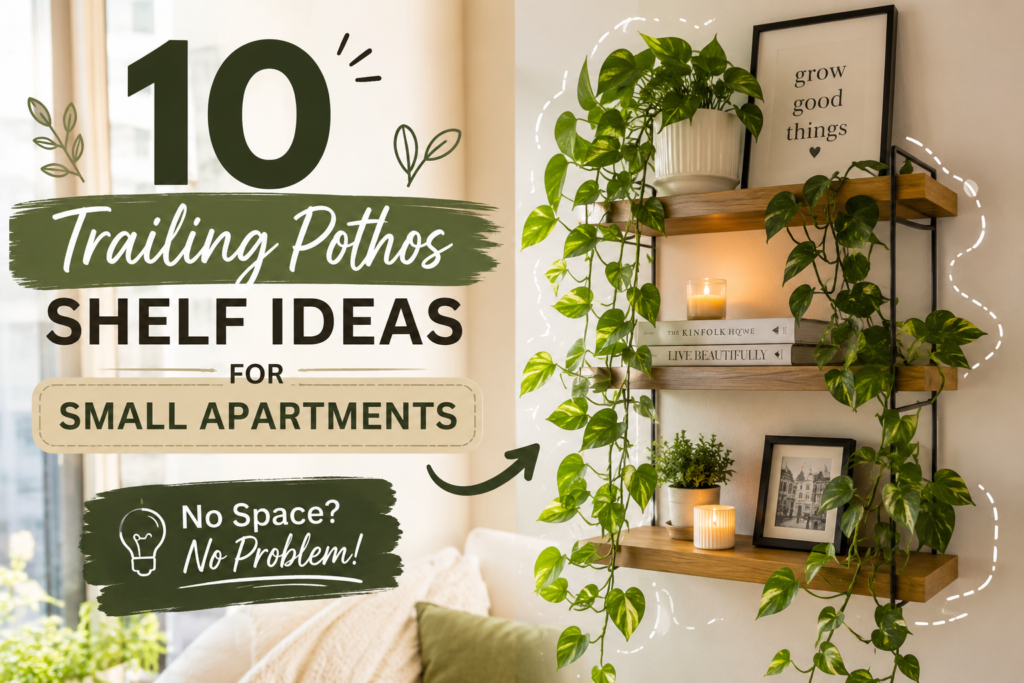
You moved into your apartment. You looked at that one bare corner — the one with the sad, empty floating shelf — and you thought: there has to be a way to make this feel like home.
You saved a hundred pins. You watched the reels. You followed every plant account on Instagram. And every time you saw those gorgeous, lush trailing vines cascading down a shelf like a green waterfall, your heart did a little thing.
Here’s the secret nobody tells you: that look is almost entirely pothos.
Not a rare, expensive plant. Not a greenhouse setup. Not a grow light system that costs $200. Just pothos — devil’s ivy — the most forgiving, fast-growing, trail-happy plant on the planet. And the right shelf setup is all you need to get from “bare rental corner” to “I can’t believe you live here” in a matter of weeks.
In this guide, you’ll get 10 specific trailing pothos shelf ideas — sorted by aesthetic, budget, and apartment size — so you can pick the one that fits your space and actually make it happen this weekend.
📌 Save this post to your plant decor board on Pinterest — you’ll want to come back to this one when you’re ready to shop.
Why Pothos Is the Best Plant for Shelf Styling (And Why Other Plants Let You Down)
Here’s something most plant styling guides won’t say out loud: not every trailing plant is actually good for shelves.
Philodendrons trail beautifully but grow slowly. String of pearls looks incredible in photos but snaps the moment you touch it wrong. Ivy needs cool temperatures that most apartments can’t provide. And anything with serious light requirements is going to look amazing for two weeks and then sad for six months.
Pothos is different — and it’s different in all the right ways.
It trails fast. A healthy pothos in decent light can grow 12–18 inches per month during spring and summer. Within a single growing season, you can go from a small 4-inch nursery pot to dramatic, flowing vines that cascade two feet off a shelf.
It tolerates low light. Most apartment shelves are nowhere near a window. Pothos doesn’t care. While other trailing plants sulk and drop leaves, pothos just keeps going — slower, yes, but still going.
It comes in varieties that suit every aesthetic. Golden pothos for that warm, classic look. Marble queen for something cooler and more editorial. Neon pothos for a pop of chartreuse energy. Cebu blue for a silvery, more elevated vibe. Same care needs, completely different aesthetics.
It forgives you. Forgot to water for two weeks? It’ll wilt dramatically, you’ll water it, and within 24 hours it’ll stand back up like nothing happened. For busy women who want a beautiful space without becoming a full-time plant caretaker, pothos is the answer.
The one thing pothos needs to look its best on a shelf? Height and length. The longer the vine, the more dramatic the effect. That’s why shelf placement matters so much — and why the 10 ideas below are organized the way they are.
10 Trailing Pothos Shelf Ideas That Actually Work in Apartments
These aren’t aspirational magazine setups that require a $3,000 renovation. Every idea below has been chosen specifically for renters — no drilling required unless noted, all budget-conscious, and all designed to work in real apartments with average light.
Idea 1: The Classic Floating Shelf Cascade
Best for: Any aesthetic · Difficulty: Beginner · Budget: $20–$40
This is the foundational pothos shelf look — and it works because it’s so simple. One floating shelf, mounted at eye level or just above, with one or two pothos plants placed toward the back edge. The vines trail forward and downward, creating that natural waterfall effect.
The key is shelf depth. A shelf that’s at least 8 inches deep gives the vines space to trail forward before they fall. Shallow 4-inch shelves work too — the vines just go straight down, which creates a different, more structured look.
Plant variety to use: Golden pothos or marble queen. Both have medium-sized leaves that look proportional on a standard shelf.
Pot tip: Use a simple white ceramic or terracotta pot. The neutrality lets the trailing vines be the visual star. Avoid pots with busy patterns — they compete with the plant.
💡 Quick tip: Place the pot at the very back corner of the shelf, not centered. Off-center placement looks more organic and natural, and it gives the vine more distance to trail before it reaches the wall.
Renter note: Use IKEA LACK shelves with the included hardware, or IKEA MOSSLANDA picture ledges — both work with standard drywall anchors and patch cleanly when you move out.
Idea 2: The Bookshelf Jungle
Best for: Maximalist and cottagecore aesthetics · Difficulty: Beginner · Budget: $15–$30
You don’t need a dedicated plant shelf to create a lush, lived-in look. A regular bookshelf — the kind you already own — is one of the best platforms for pothos because the multiple levels let you stagger plants at different heights.
Place one pothos on the top shelf to trail downward past the books on the second shelf. Place another on a middle shelf to fill in the lower section. Within a few months, the vines interweave between your books, candles, and objects in a way that looks genuinely curated rather than arranged.
The rule of thirds: On each shelf, aim for roughly one-third plants, two-thirds objects. More than that starts to feel cluttered; less starts to feel sparse.
⚠️ Common mistake: Stuffing every shelf level with plants. One or two well-placed pothos with long vines look far more intentional than five small plants crammed in everywhere. Restraint is the secret to making this look expensive.
Plant variety to use: Marble queen works beautifully here because its white-and-green variegation creates contrast against dark books and objects. Neon pothos adds a pop of bright green that makes the whole shelf feel alive.
Idea 3: The Macramé Hanger Setup
Best for: Boho and cottagecore aesthetics · Difficulty: Beginner · Budget: $15–$35
Macramé plant hangers are having a moment, and for good reason — they add texture, warmth, and verticality to a space without taking up any floor or shelf space. For a rental, they’re ideal because they hang from a single ceiling hook (or a tension rod between walls) and leave no permanent marks.
The trick to making macramé look elevated rather than cheesy is the combination. Hang one or two macramé planters at different heights, with pothos in each, and let the vines trail downward naturally. The contrast between the warm beige of the macramé and the bright green of the pothos is incredibly satisfying.
Best heights: One hanger at ceiling height, one at about 5 feet. The varying lengths create visual layering that makes the corner feel intentional.
💡 Quick tip: A single ceiling command hook rated for 5 lbs can hold a small pothos in a lightweight plastic nursery pot with a macramé hanger. No drilling, no damage, fully renter-friendly. Look for 3M Command Utility Hooks — $6 at Target.
Pot inside the hanger: Use the nursery pot your pothos came in (most macramé hangers fit a standard 4-inch or 6-inch nursery pot). This saves money and means you don’t have to repot unnecessarily.
Idea 4: The Window Ledge Row
Best for: Minimalist and Japandi aesthetics · Difficulty: Beginner · Budget: $20–$50
If you have a windowsill with any real depth — or a narrow ledge near a window — a row of pothos in identical pots is one of the cleanest, most satisfying plant looks you can create in an apartment.
The repetition of form is what makes this work. Three to five identical terracotta pots, same size, evenly spaced, all with pothos trailing over the front edge toward the light. It reads as intentional and styled rather than accidental.
The light benefit: Pothos near a window (even an indirect-light window) grows noticeably faster and more vigorously than pothos in a dark corner. A window ledge setup will give you longer, more dramatic trailing vines in less time.
Variety to use: For this minimalist look, go with one consistent variety — all golden or all marble queen. Mixing varieties in an aligned row looks busy rather than curated.
| Pot Style | Aesthetic Match | Price Range |
|---|---|---|
| Terracotta | Organic, natural, cottagecore | $3–$8 each |
| White ceramic | Minimalist, Japandi, modern | $5–$12 each |
| Black matte | Moody, editorial, maximalist | $8–$15 each |
| Woven basket | Boho, earthy, relaxed | $10–$20 each |
Idea 5: The Tension Rod Curtain
Best for: Boho and maximalist aesthetics · Difficulty: Intermediate · Budget: $25–$60
This one stops guests mid-sentence.
A tension rod installed in a doorway, alcove, or between two walls becomes a hanging bar from which you suspend multiple macramé hangers or S-hook planters at staggered heights. The result is a living curtain of trailing pothos — a literal green wall that requires zero permanent fixtures.
How to set it up:
- Get a heavy-duty tension rod rated for at least 20 lbs (not a flimsy curtain rod — look for closet tension rods)
- Hang S-hooks along the rod at 6–8 inch intervals
- Suspend small pothos plants in lightweight nursery pots or hanging planters from each hook
- Let the vines trail naturally downward
Within 3–4 months, the vines will be long enough that they create a genuine layered, textured curtain effect.
💡 Quick tip: Use this in a doorway that leads to a less-used room (like a home office or reading nook). Walking through a living green curtain every time you enter a room is genuinely mood-altering. It transforms a functional architectural feature into an experience.
Weight warning: Keep each planter under 3 lbs. Use plastic or fabric grow pots instead of ceramic inside the hangers. Tension rods are not designed for heavy loads.
Idea 6: The Corner Column
Best for: Minimalist, modern, and Japandi aesthetics · Difficulty: Beginner · Budget: $40–$80
This idea plays with verticality in a way that most shelf setups don’t.
Instead of one shelf, use a slim floor-to-ceiling plant stand or a ladder shelf placed in a corner. Put pothos at the highest level and let the vines trail downward past each subsequent level. Over time, a single plant can fill the entire height of the corner with cascading green.
The ladder shelf trick: A 5-tier bamboo ladder shelf ($35–$60 on Amazon) is one of the most versatile pieces of furniture you can own in a small apartment. It’s lightweight, renter-friendly, takes up almost no floor space, and is specifically designed to display things at multiple heights. Place a pothos on the top tier, smaller plants or objects on the lower tiers, and let the vines do the work.
⚠️ Common mistake: Buying a very wide shelf when floor space is limited. A shelf that’s 12 inches wide and 60+ inches tall takes up far less floor space than it looks like in photos, while still providing the vertical drama that makes a corner feel designed.
Complementary plants: Style one or two other plants on the lower shelves to create a complete vignette. A small snake plant on the bottom tier, a trailing pothos at the top, and a small succulent in the middle is a classic, low-maintenance combination that looks cohesive and curated.
Idea 7: The Above-Cabinet Drape
Best for: Any aesthetic · Difficulty: Beginner · Budget: $10–$25
This is the most underused pothos placement in apartment styling — and it might be the easiest.
Most apartments have kitchen cabinets that don’t reach the ceiling. That gap between the top of your cabinets and the ceiling is wasted space in 99% of homes. A pothos placed on top of the cabinets with long vines trained to drape down the front transforms this dead zone into one of the most visually interesting elements in your kitchen.
No shelf purchase required. No installation. Just place the pot, tuck the vine over the front edge, and let gravity do the rest.
Why it works: The height of kitchen cabinets (typically 7–8 feet) means the vines have a long distance to travel before they reach eye level — which, over time, creates an incredibly dramatic trailing effect without you doing anything.
Light consideration: Above-cabinet pothos often gets less light than other placements. Use a golden pothos here — it’s the most light-tolerant variety and maintains its color even in dim conditions.
💡 Quick tip: Water this pothos with a watering can that has a long, narrow spout so you can reach it without moving the pot. Or invest in a $12 self-watering insert that keeps the soil consistently moist between your weekly watering rounds.
Idea 8: The Reading Nook Frame
Best for: Cottagecore, cozy, and maximalist aesthetics · Difficulty: Beginner-Intermediate · Budget: $30–$70
If you have a reading chair, a small sofa corner, or any defined “cozy zone” in your apartment, framing it with pothos is the move.
The idea is simple: use two tall side tables, bookshelves, or plant stands placed on either side of the seating area, with trailing pothos on each. The vines grow toward each other over time, framing the seating area in a natural, organic arch of green that makes the space feel like a tucked-away sanctuary.
Creating the arch effect: This takes patience — about 4–6 months of intentional vine training — but the result is extraordinary. As the vines grow, gently redirect them toward the center using small adhesive hooks or vine clips on the wall above the seating area. Over time, the vines create a soft, living arch.
Why this aesthetic works psychologically: Humans are evolutionarily drawn to spaces that have a defined overhead canopy and clear sightlines outward. The “refuge and prospect” theory in environmental psychology suggests that spaces enclosed slightly from above feel safer and more restorative. A pothos arch literally makes your reading corner feel more like a sanctuary — not just aesthetically, but neurologically.
Idea 9: The Propagation Display
Best for: Minimalist, modern, and laboratory-chic aesthetics · Difficulty: Beginner · Budget: $15–$40
This is the styling idea that does double duty: it looks gorgeous and it gives you free plants.
Line a windowsill, shelf, or floating ledge with a row of glass vessels — bud vases, test tubes, wine glasses, mason jars — each containing a single pothos cutting in water. As the cuttings root and grow, the trailing vines spill over the edges of the vessels and cascade downward.
The visual effect is clean, architectural, and surprisingly sophisticated. The glass vessels let you see the root systems developing, which adds an additional layer of visual interest that fully soil-potted plants can’t provide.
Best glass vessels to use:
- IKEA BESTÅM bud vases ($3 each)
- Clear test tube vases on a wooden stand ($15–$25 for a set of 5–8)
- Recycled glass bottles (olive oil bottles, wine bottles, sparkling water bottles)
- Simple mason jars for a more cottagecore feel
💡 Quick tip: Change the water every 7–10 days to prevent algae buildup and keep the roots healthy. Add a single drop of liquid fertilizer to the water once a month and the cuttings will grow noticeably faster.
Idea 10: The Staggered Wall Gallery with Plants
Best for: Maximalist and eclectic aesthetics · Difficulty: Intermediate · Budget: $50–$120
The most visually impactful setup on this list — and the one most likely to make someone ask “can you decorate my apartment too?”
Instead of one shelf, use 4–6 small floating shelves arranged in an asymmetric gallery wall pattern. Mix different shelf sizes (some 8 inches wide, some 12 inches, some 16 inches) at different heights, staggered across the wall. Place pothos plants on the higher shelves, with vines trailing down past the lower ones. Fill the remaining shelves with books, candles, art prints, and small objects.
The pothos vines become the connective tissue that ties all the separate elements together into a cohesive composition.
Gallery wall spacing tip: Leave at least 8–12 inches between shelves vertically so the trailing vines have room to breathe before the next shelf interrupts them. Too little space between shelves makes the vines look cramped.
⚠️ Common mistake: Making all shelves the same size and spacing them at perfectly even intervals. Symmetry in gallery walls looks rigid and institutional. Asymmetry looks collected, personal, and intentional — even if it takes a little more thought upfront.
What You’ll Actually Need to Pull This Off
You don’t need to spend a lot. Here’s a practical shopping list for most of the setups above:
1. IKEA MOSSLANDA Picture Ledge (55 or 19 inch) — The best renter-friendly floating shelf that comes pre-drilled and installs with two screws. Cleans up almost invisibly when you move out. $8–$15 · [ADD AFFILIATE LINK]
2. Bamboo Ladder Shelf (5-tier) — Perfect for the corner column idea. Lightweight, stylish, no installation required. $35–$55 on Amazon · [ADD AFFILIATE LINK]
3. Pack of Terracotta Pots (4-inch, 6-inch) — Terracotta is universally flattering and promotes healthy roots by allowing airflow. $12–$20 for a pack of 5 · [ADD AFFILIATE LINK]
4. 3M Command Hooks (5 lb rated) — The single most important renter tool for macramé and wall-mounted plant hangers. Removes cleanly without damage. $6–$10 at Target or Amazon · [ADD AFFILIATE LINK]
5. Heavy-Duty Tension Rod — For the living curtain setup. Look for closet tension rods that hold 20+ lbs rather than standard curtain rods. $15–$25 · [ADD AFFILIATE LINK]
Budget alternative: Before buying anything, look at what you already have. A pile of books stacked on a windowsill can serve as a platform. A kitchen stool can hold a plant at shelf height. Clear glass jars from your recycling can become propagation vessels. Start with what you have, then shop for what you actually need.
Mistakes That Ruin a Beautiful Pothos Shelf (And How to Avoid Them)
1. Putting the pot too close to the front edge of the shelf When you center the pot on the shelf, the vine has nowhere to trail — it just hangs straight down from wherever the pot sits. Instead, push the pot to the back of the shelf so the vine has the full shelf depth to travel before it cascades down. This creates a much more natural, lush look.
2. Using pots that are too large An oversized pot overpowers the shelf and draws attention to the container rather than the plant. For most shelf setups, a 4-inch or 6-inch pot is ideal. Go up to an 8-inch pot only for a large, dedicated shelf with nothing else on it.
3. Never rotating the plant Pothos grows toward light. If you never rotate the pot, all the new growth will face one direction and the other side of the plant will look sparse and bare. Give the pot a quarter turn every 2–3 weeks to encourage even, full growth in all directions.
4. Watering on a schedule instead of checking the soil The most common plant mistake period. Pothos on a shelf in lower light needs water far less frequently than the same plant in a bright window. Ignore the calendar and use the finger test: stick your finger 2 inches into the soil. If it feels dry, water thoroughly. If it still feels moist, wait another 3–5 days.
5. Choosing fast-draining shelf surfaces without protection Trailing vines that touch wooden shelves can leave moisture marks over time. Place a small saucer under every pothos pot. It protects the shelf and gives the pot a finished, intentional look rather than a “just placed here” look.
Your Pothos Shelf Questions Answered
Q: How long does it take for pothos to trail long enough to look good on a shelf?
A: In a spot with bright indirect light, pothos can grow 12–18 inches per month during spring and summer. That means in 3–4 months, starting from a small nursery plant, you can have vines trailing 3–4 feet. In lower light, expect 6–12 inches per month — still meaningful growth, just more gradual. The fastest way to speed things up is better light and monthly fertilizing from March through September.
Q: What pothos variety trails the longest and fastest?
A: Golden pothos is consistently the fastest grower and longest trailer of all the common varieties. It’s also the most light-tolerant, which makes it ideal for shelf placements that aren’t directly near a window. If you want the longest vines in the shortest time, start with golden pothos.
Q: Can I put pothos on a shelf with no natural light at all?
A: Technically yes — pothos is one of the most low-light tolerant plants available. But “surviving” and “thriving” are different things. In very low light, growth slows dramatically and the variegation on varieties like marble queen tends to fade to plain green. If your shelf truly gets no natural light, consider a small $15–$20 grow light on a timer. Even 6–8 hours of artificial light per day makes a visible difference in growth rate.
Q: How do I keep the vines from getting tangled and messy?
A: The key is intentional training, not just letting the vine grow wherever it wants. Every 2–3 weeks, gently redirect any vines that are going the wrong direction by wrapping them loosely around the shelf support or tucking them behind objects. Small adhesive vine clips ($8 for a pack of 20) let you stick the vine to the wall and guide it exactly where you want it to go.
Q: Is pothos safe to have in a home with cats?
A: Pothos is toxic to cats and dogs if ingested — it contains calcium oxalate crystals that can cause oral irritation, drooling, and vomiting. For most shelf placements above pet height, the risk is low. But if you have a climbing cat or a curious dog, consider placing pothos only on very high shelves, or swap to a pet-safe trailing alternative like hoya or spider plant.
Your Beautiful Apartment Corner Is Closer Than You Think
You already have everything you need to start. A single pothos plant from a garden center, a shelf you already own, and one afternoon is genuinely all it takes to begin.
The lush, trailing, magazine-worthy plant corner you’ve been saving to your Pinterest board for years isn’t about having the perfect apartment or the ideal light. It’s about choosing the right plant — one that grows enthusiastically toward wherever you put it — and giving it a stage to perform on.
That’s pothos. Every time.
Pick one idea from this list that fits your space right now. Not the most elaborate one, not the most expensive one — the one you can actually do this week. Start there. Come back in three months and you’ll barely recognize that corner.
📌 Loved this post? Save it to your plant decor board on Pinterest so you can reference it when you’re ready to set up each new shelf.
Also read:
- Pothos Care Guide for Complete Beginners — the Only Guide You’ll Ever Need
- Is Pothos Toxic to Cats and Dogs? What Every Pet Owner Needs to Know
- How to Grow a Pothos Living Wall in Your Apartment — A Renter’s Guide
Want a free Pothos Styling Cheat Sheet? It covers the 10 setups above in a printable one-page format with measurements, pot sizes, and a shopping list. [Get it here → ADD LINK]