
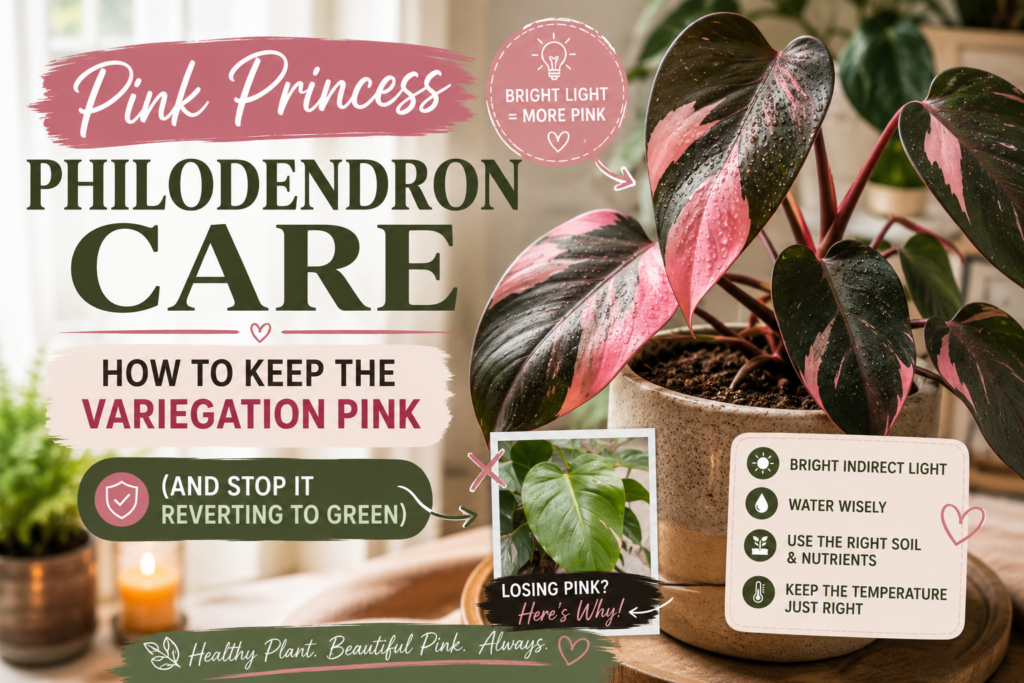
You spent $80 on a pink princess philodendron.
You brought it home, set it in the perfect spot, posted a photo, and watched the likes roll in. For a few weeks, it was everything — those dramatic dark leaves with the blush pink splashes looked like something out of a luxury plant shop.
Then, slowly, something started to change.
The new leaves came in smaller. Then they came in with less pink. Then one morning you looked at your PPP and the newest leaf — the one you’d been watching unfurl for two weeks — was almost completely green.
Your heart sank. You started googling. You found seventeen different conflicting answers. And now you’re here.
Here’s what’s actually happening: your pink princess philodendron isn’t sick. It isn’t dying. It’s reverting — and reversion is one of the most misunderstood things in houseplant care. The good news is that it’s almost always fixable once you understand why it happens and what specifically triggers it.
In this guide, you’ll learn exactly why PPP variegation reverts to green, the precise light threshold that keeps pink leaves coming, and the one pruning move that reliably brings the variegation back — so your investment stays as beautiful as the day you brought it home.
📌 Save this post to your rare plants board on Pinterest — you’ll want to come back to this one every time a new leaf unfurls.
Why Your Pink Princess Philodendron Is Losing Its Pink (The Real Reason)
Most people blame the wrong thing. They think their PPP is going green because of water, or soil, or the wrong fertilizer. Those things matter for overall health — but they have almost nothing to do with variegation.
Here’s what’s actually happening at a cellular level, explained without the botany lecture.
The pink coloring in a pink princess philodendron comes from cells that lack chlorophyll — the green pigment that plants use to photosynthesize and make energy. Pink cells are essentially non-photosynthetic. They’re beautiful, but from the plant’s perspective, they’re a liability.
Your plant is always trying to survive. When it doesn’t have enough light, it does the logical thing: it produces more chlorophyll-containing (green) cells because those cells are the ones that make energy from light. The pink cells get pushed out. The leaves come in greener and greener because the plant is compensating for an energy deficit.
This is the core truth about PPP variegation: pink leaves are a luxury your plant only produces when it has more than enough light. When light is abundant, the plant can “afford” to grow pink cells. When light is scarce, it reverts to full green production to survive.
This also explains why PPP reversion is so common in US apartments. Our homes are significantly darker than we think. What feels like a bright, sunny room to a human is actually relatively dim by plant standards — especially in winter, or in apartments that face north or east.
The myth that needs busting: variegation does NOT revert because of watering, humidity, fertilizer, or pot size. Those things affect the plant’s health and growth speed, but they don’t determine whether new leaves come in pink or green. Light is the single dominant factor.
The Complete PPP Care Guide: How to Keep Every New Leaf Pink
Getting consistent variegation from a pink princess philodendron requires you to get three things right: the light situation, the pruning strategy, and the overall plant health baseline. Think of it as a three-legged stool — all three legs need to be in place.
Here’s how to manage each one.
Step 1: Find the Right Light — The Threshold That Triggers Pink
This is the most important thing you’ll do for your PPP, and it requires some honest assessment of your space.
What pink princess philodendron actually needs: Bright, indirect light for a minimum of 6 hours per day. Not “some light.” Not “near a window.” Bright indirect light — meaning the plant should be close enough to a window that you can comfortably read a book by that light source alone, without turning on a lamp.
The window guide:
- South-facing window: Ideal. Place the plant 2–4 feet back from the glass to avoid direct sun scorching the leaves. This is the PPP sweet spot.
- East-facing window: Good. Morning light is gentle and bright. Place the plant directly on or very close to the windowsill.
- West-facing window: Acceptable. Afternoon sun is more intense — keep the plant 3–4 feet back, or use a sheer curtain to diffuse the light.
- North-facing window: Not enough. North-facing windows in the US receive the least natural light year-round. A PPP in a north-facing room will almost certainly revert. This is a grow-light situation.
💡 Quick tip: Hold your hand 12 inches above a white piece of paper in your intended plant spot at midday. If the shadow is sharp and clear, you have enough light for pink variegation. If the shadow is faint or blurry, the light is too low and you’ll need to supplement with a grow light.
The grow light solution for dark apartments: A simple clip-on or standing grow light set to run 10–12 hours per day can completely transform your PPP’s variegation in 4–6 weeks. You don’t need an expensive horticultural setup — a $25–$40 LED grow light from Amazon set on a timer works well. Look for a full-spectrum bulb (5000–6500K color temperature) positioned 6–12 inches above the plant.
Step 2: Master the Watering Schedule (Because Root Rot Kills PPP Fast)
While watering doesn’t affect variegation directly, root rot will kill your plant before you ever get to see another pink leaf. PPP is more sensitive to overwatering than most philodendrons — and it’s the number one reason expensive plants die in the first year.
The golden rule: Water only when the top 2 inches of soil are dry. Not the top half-inch. Two full inches. Stick your finger in — if it comes out with damp soil clinging to it, wait. If it comes out clean and dry, it’s time to water.
How to water correctly:
- Water thoroughly until water flows freely from the drainage holes
- Let the pot drain completely — never let it sit in standing water
- Empty the saucer after 30 minutes
- Wait until the top 2 inches dry out before watering again
In a bright spot, this typically means watering every 7–10 days in summer and every 12–16 days in winter. In lower light, the soil dries slower — push the interval out accordingly.
Soil matters too: PPP performs best in a chunky, well-draining mix. If you’re using standard potting soil straight from the bag, add 20–30% perlite to improve drainage. This one change alone reduces the risk of root rot significantly because it prevents water from pooling around the roots.
⚠️ Common mistake: Watering on a fixed schedule (e.g., “every Sunday”). The amount of water your plant needs varies by season, light level, pot size, and humidity. A schedule-based approach almost always leads to overwatering in winter or underwatering in summer. Check the soil; ignore the calendar.
Step 3: The Pruning Move That Brings the Pink Back
This is the most actionable thing in this entire guide — and the one most PPP owners never learn.
When a pink princess philodendron produces a fully green or heavily-green leaf, most people leave it on the plant hoping the next one will be better. This is the wrong move. Here’s why.
Plants grow from their most recent growth point. The newest leaf your PPP produces sets the “template” that influences what the next leaf will look like. If a green leaf is the most recent growth, the plant tends to continue in the same direction — producing more green leaves in subsequent growth cycles.
The fix: When your PPP produces a leaf that is more than 70% green (little to no pink), prune it off. Cut the stem back to just above a node — the small bump on the stem where a leaf or root can emerge. This forces the plant to produce a new growth point, and that new growth point has a fresh opportunity to express variegation.
How to make the cut:
- Use clean, sharp scissors or pruning shears (disinfect with rubbing alcohol first)
- Cut the stem about ¼ inch above a node
- Remove the fully green leaf and its stem
- The plant will direct energy to the next growth point, which often produces a more variegated leaf
💡 Quick tip: After pruning a green leaf, increase light by 10–15% for the next 4–6 weeks. This extra light availability right when the new growth point is developing makes a meaningful difference in how much pink the next leaf expresses. Move the plant 6 inches closer to the window, or add 2 hours to your grow light timer.
Patience note: It takes 4–8 weeks to see the result of a pruning cut, because PPP grows relatively slowly compared to pothos or monstera. Make the cut, adjust the light, and give it time. The wait is worth it.
Step 4: Temperature and Humidity — The Support System
These won’t make or break your variegation on their own, but they affect the plant’s overall health and growth speed — which in turn affects how frequently you get new leaves and how much energy the plant has to express pink cells.
Temperature: PPP is happiest between 65°F and 85°F. It does not tolerate temperatures below 55°F — cold drafts from windows, air conditioning vents, or exterior doors in winter can stress the plant and slow growth significantly. Keep it away from vents and drafty windows.
Humidity: Aim for 50–70% relative humidity. Most US apartments run at 30–40% in winter, which is too dry for optimal PPP growth. Signs of low humidity include crispy leaf edges, slow unfurling of new leaves, and browning of leaf tips.
Practical humidity solutions:
- Pebble tray: Place a tray of pebbles under the pot, fill with water to just below the top of the pebbles, and set the pot on top. As the water evaporates, it raises humidity around the plant. Free if you already have a tray and pebbles.
- Humidifier: A small $30–$40 ultrasonic humidifier near your plant area makes the most significant difference. If you have multiple tropical plants, one humidifier serves all of them.
- Plant grouping: Clustering plants together raises the local humidity slightly through transpiration. Place your PPP near your other tropicals.
What doesn’t work: Misting. It feels productive but it raises humidity for only minutes and the standing water on leaves can encourage fungal issues. Skip the misting; invest in a pebble tray at minimum.
Step 5: Fertilizing for Healthy, Variegated Growth
Fertilizer won’t change whether your leaves come in pink or green — but it determines how fast your plant grows and how robust each new leaf is. A well-fed PPP produces new leaves more frequently, which means more opportunities for pink expression.
The fertilizing schedule:
- Spring through summer (March–September): Fertilize once every 4 weeks with a balanced liquid fertilizer diluted to half the recommended strength. Half-strength prevents fertilizer burn, which PPP is somewhat susceptible to.
- Fall and winter (October–February): Stop fertilizing entirely, or reduce to once every 8 weeks at quarter strength. Growth slows in winter and excess fertilizer salts accumulate in soil when the plant isn’t actively using nutrients.
What to use: A balanced 20-20-20 liquid fertilizer or a fertilizer specifically formulated for aroids (the plant family PPP belongs to). Look for formulas that include micronutrients like calcium, magnesium, and iron — these support healthy cell development and can contribute to more vibrant coloring in the leaves.
The flush: Every 3–4 months, water the plant thoroughly three times in a row (let it drain completely between each watering) to flush accumulated fertilizer salts from the soil. This prevents salt buildup, which causes brown leaf edges and can suppress new growth.
Step 6: Repotting — When and How to Do It Without Stress
PPP does not need frequent repotting. In fact, repotting too often stresses the plant and can temporarily halt growth — which delays your next pink leaf.
When to repot: When roots are visibly growing out of the drainage holes, or when the plant dries out within 2–3 days of watering (a sign the root ball has consumed most of the soil and there’s not enough growing medium left). For most plants, this happens every 12–18 months.
How to repot: Go up only one pot size — 2 inches larger in diameter. Jumping to a much larger pot means excess wet soil surrounding the roots, which dramatically increases the risk of root rot.
Timing: Repot in spring (March–April) when the plant is entering its active growth season and can recover quickly. Avoid repotting in fall or winter.
Signs you’ve waited too long to repot: The plant seems to dry out impossibly fast, growth has stalled despite good light and care, or you can see a mass of white roots circling the bottom of the pot when you lift it.
Is Your PPP Actually a Real Pink Princess? How to Tell at Purchase
This is worth addressing because fake PPPs are unfortunately common — especially on Etsy and at pop-up plant markets. Some sellers use dyes, heat stress, or variegated sport cuttings that will never hold their color to sell plants marketed as pink princess philodendrons.
Signs of a genuine PPP:
- Scientific name should be Philodendron erubescens ‘Pink Princess’ — ask the seller to confirm this
- The pink areas on leaves should be matte, not glossy or uniformly colored. Real variegation has an uneven, natural distribution
- The stems should show pink or light blush coloring, not just the leaves
- A real PPP grown in good light will have new growth that shows some pink variation — it won’t be 100% green while being sold as a pink variety
Signs of a potentially fake or dyed plant:
- Unnaturally bright, uniform pink color that looks almost neon
- Pink that appears only on the leaf surface and scrapes off with a fingernail (this is literally paint or dye)
- A price that seems too good to be true (under $15 for a “pink princess” is a major red flag)
- Seller can’t confirm the species name or growing conditions
Buying tip: Purchase from a reputable nursery, a well-reviewed Etsy shop with clear photos showing multiple growth stages, or a trusted plant swap community. Ask to see photos of new growth before committing.
What You’ll Actually Need for a Happy, Pink PPP
You don’t need to spend a fortune — but a few targeted tools make a real difference:
1. Full-Spectrum Grow Light (LED, 5000K+) If your apartment doesn’t have a genuinely bright window, this is non-negotiable for PPP variegation. A clip-on LED grow light on a 10-hour timer is the single best investment for keeping your pink leaves pink. $25–$45 on Amazon · [ADD AFFILIATE LINK]
2. Moisture Meter Takes the guesswork out of watering. Insert the probe 2 inches into the soil — a reading of 3 or below means it’s time to water. Prevents both overwatering and underwatering simultaneously. $10–$15 on Amazon · [ADD AFFILIATE LINK]
3. Perlite (for soil amendment) Mix 20–30% perlite into your potting mix to improve drainage and dramatically reduce root rot risk. A bag lasts for years. $8–$12 at any garden center · [ADD AFFILIATE LINK]
4. Liquid Aroid Fertilizer (balanced formula) Formulated specifically for the philodendron family. Provides the micronutrients aroids need for vibrant leaf development. $12–$18 · [ADD AFFILIATE LINK]
5. Small Ultrasonic Humidifier If you’re serious about PPP long-term, a humidifier near your plant corner raises ambient humidity to tropical levels and benefits every tropical plant in the area. $30–$45 on Amazon · [ADD AFFILIATE LINK]
Budget alternative: Before buying anything, optimize your light first. Move the plant to your brightest window, clean the window glass (dirty glass reduces light transmission), and remove any sheer curtains between the plant and the light source. This costs nothing and can make a noticeable difference in 4–6 weeks.
Mistakes That Are Silently Killing Your PPP’s Pink Variegation
1. Keeping it too far from a light source “Near a window” is not specific enough. Near a window in winter with low-angle sun, partially blocked by a tree, is very different from near a window in summer facing south. Measure the distance, test with the shadow method, and be honest about your light situation.
2. Leaving fully green leaves on the plant A fully green leaf signals the plant to continue green production. Prune it. The cut feels drastic the first time you do it — but within 6–8 weeks you’ll understand why every experienced PPP grower recommends it.
3. Misting instead of addressing humidity properly Misting raises humidity for minutes. Your PPP lives in that spot 24 hours a day. A pebble tray or humidifier provides sustained humidity that actually makes a difference.
4. Repotting too frequently Every time you repot, you stress the root system and the plant diverts energy from leaf production to root recovery. Unless the plant is clearly rootbound, resist the urge to repot just because it seems like a nice thing to do.
5. Buying the cheapest option without verifying authenticity A dyed or unstable variegated cutting that goes fully green within six months is not a bargain — it’s a $20–$30 loss plus months of disappointment. Pay the premium for a verified PPP from a reputable source. It saves money and heartbreak in the long run.
Your Pink Princess Philodendron Questions Answered
Q: Why did my PPP go from beautiful pink leaves to all-green new growth?
A: This is variegation reversion, and it’s almost always caused by insufficient light. When your plant doesn’t get enough bright indirect light, it produces more chlorophyll-containing green cells to compensate — and pink cells get left behind. Move the plant to your brightest window, or add a grow light on a 10-hour daily timer. After 4–6 weeks of improved light, most plants begin producing more variegated growth again.
Q: Can variegation come back once a plant has fully reverted to green?
A: Yes — but it requires intervention. A fully green PPP won’t spontaneously become pink again on its own, even with good light. You need to prune the plant back to a node, increase light significantly, and encourage new growth. The new growth that emerges from that node often shows variegation again, especially if light conditions are improved. It’s a slower process but it works in most cases.
Q: How do I know if my PPP has root rot?
A: Early signs include yellowing lower leaves, soil that stays wet for longer than 10–12 days after watering, and a faint sour or musty smell from the pot. To confirm, gently remove the plant from its pot and check the roots. Healthy roots are white or light tan and firm. Rotted roots are brown, black, mushy, and may fall apart when touched. If you find rot, remove all affected roots with clean scissors, let the root ball air dry for an hour, and repot in fresh, well-draining mix.
Q: Is pink princess philodendron safe for cats and dogs?
A: No. Like most philodendrons, PPP contains calcium oxalate crystals that are toxic to cats and dogs if ingested. Symptoms include oral pain, drooling, pawing at the mouth, and vomiting. Keep PPP on high shelves out of reach of pets, or consider a pet-safe alternative. If you suspect your pet has eaten part of the plant, contact your vet immediately.
Q: What’s the difference between pink princess philodendron and pink congo?
A: This is an important distinction. Pink princess philodendron (Philodendron erubescens ‘Pink Princess’) has genuine genetic variegation — its pink coloring is stable and heritable. Pink congo philodendron has pink leaves that are induced artificially through chemical treatment. The pink coloring on a pink congo will fade completely and permanently within 6–12 months as new growth comes in green. Pink congo is often sold fraudulently as pink princess. Always verify the variety name before purchasing.
You Can Have a Thriving, Pink-Leafed PPP — Starting Today
Here’s the thing about pink princess philodendrons: they’re not actually that difficult. They just need the right conditions, a little honest assessment of your light situation, and the confidence to prune when the plant tells you to.
The women who have the most stunning PPPs aren’t doing anything magical. They’ve figured out their light, they water by feel not by schedule, and they prune without hesitation when a green leaf appears. Those three things alone account for 90% of PPP success.
Your plant can absolutely look like the ones you’ve been saving on Pinterest. It just needs you to understand what it’s asking for — and now you do.
📌 Found this helpful? Save it to your rare plants board on Pinterest so you can reference it every time a new leaf starts to unfurl.
Also read:
- Is the Pink Princess Philodendron Worth $80? An Honest Review After One Year
- How to Propagate Pink Princess Philodendron: Step-by-Step in Water and LECA
- Best Rare Houseplants Worth Buying in 2026 — Ranked by Care Ease and Aesthetic Payoff
- Pink Houseplants That Look Incredible Together: A Styling and Pairing Guide
Want a free PPP Care Card? A printable one-page care reference covering light, water, humidity, fertilizer, and the pruning schedule — everything in this post on a single sheet you can pin near your plant. [Get it free here → ADD LINK]