
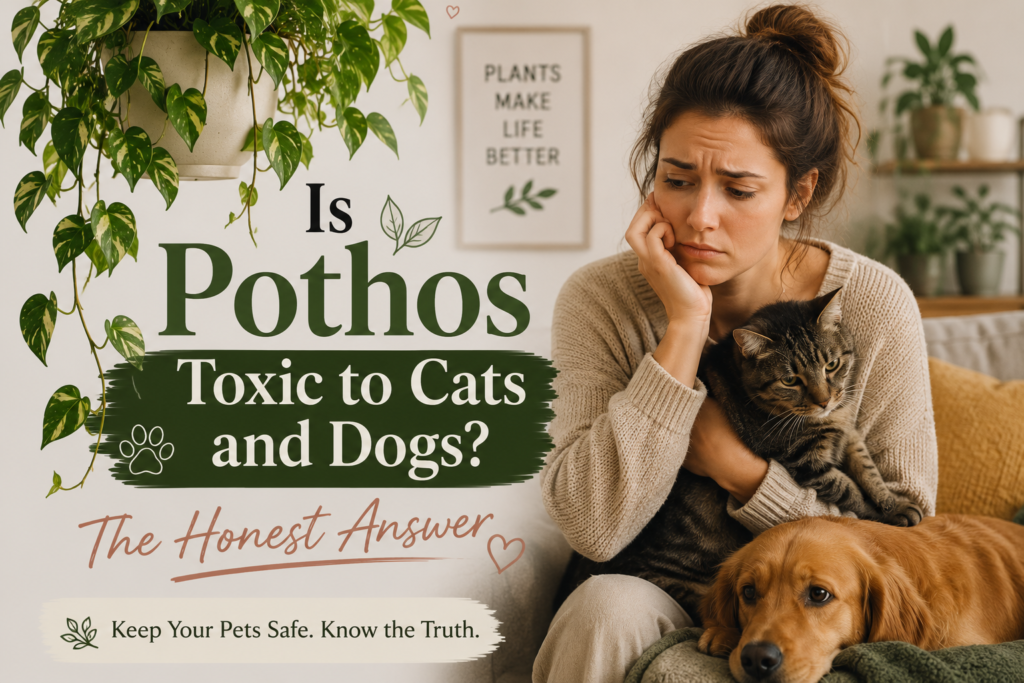
You just got home from the garden center with the most gorgeous golden pothos. You’re already picturing it trailing from that floating shelf in your living room — long, lush vines cascading down like the plant accounts you follow on Instagram.
Then your cat walks over, sniffs it, and starts chewing a leaf.
Your stomach drops. You grab your phone and start searching. And within thirty seconds you’re deep in a spiral of conflicting information — some sites say pothos is mildly toxic, some say it’s deadly, some say don’t panic, some say rush to the emergency vet right now.
Here’s the honest answer: pothos is toxic to cats and dogs. Full stop. But the full picture is more nuanced than most websites tell you — and knowing the details will help you make a calm, informed decision instead of a panicked one.
In this guide, you’ll learn exactly what makes pothos dangerous, what the actual risk level is for your pet, what symptoms to watch for, what to do if your pet eats some, and — because you probably still want trailing plants in your home — five gorgeous pet-safe alternatives that look just as beautiful as pothos.
📌 Save this post to your pet-safe plants board on Pinterest — every plant-loving pet parent needs this one.
What Makes Pothos Toxic? The Science in Plain English
Pothos (Epipremnum aureum) contains calcium oxalate crystals — microscopic, needle-shaped crystals that are found throughout every part of the plant: the leaves, the stems, and the roots.
Think of calcium oxalate crystals like tiny shards of glass. When your cat or dog chews a pothos leaf, the plant cells rupture and release these crystals directly into the soft tissue of the mouth, tongue, throat, and digestive tract. The crystals physically penetrate the tissue and cause immediate, intense irritation.
This is why the reaction happens so fast. Your pet doesn’t have to swallow and digest the plant for the toxicity to take effect — the damage starts the moment they bite down and the crystals make contact with the soft tissue of the mouth.
Why this matters for severity: Because the irritation is immediate and intense, most pets stop eating the plant on their own after a few bites. The burning sensation in the mouth is so uncomfortable that self-limiting is common. This is different from toxins that have no taste or immediate sensation — those are far more dangerous because a pet can consume a large amount before any symptoms appear.
That said, self-limiting does not mean safe. Even a small amount of pothos can cause real discomfort and distress, and some pets — particularly curious cats and persistent chewers — will push through the discomfort and eat more than a few bites.
The ASPCA classification: The American Society for the Prevention of Cruelty to Animals (ASPCA) lists pothos as toxic to both cats and dogs under their Animal Poison Control resources. They categorize it under plants that cause oral irritation, pain, swelling, excessive drooling, vomiting, and difficulty swallowing.
⚠️ Common mistake: Assuming that because pothos is “just mildly toxic,” it’s fine to keep around pets without any precautions. Mild toxicity still means real suffering for your animal. Even if the outcome is rarely life-threatening, a pet that has eaten pothos is in significant pain and discomfort for hours. That matters.
The Real Risk Level: What “Toxic” Actually Means for Cats vs. Dogs
Not all toxins are created equal, and the severity of a pothos reaction depends on several factors: the size of the pet, how much they ate, and whether they swallowed any.
Here’s an honest breakdown by pet type.
Cats and Pothos
Cats are at moderate to high risk from pothos exposure for a few specific reasons.
First, cats are obligate carnivores — their digestive systems are not designed to process plant material, and they’re generally more sensitive to plant toxins than dogs. Second, some cats are drawn to chewing plants specifically because of the texture, and they may persist through the initial discomfort more than dogs do.
The additional cat-specific risk: Calcium oxalate crystals can cause swelling of the tongue, throat, and upper airway in cats. While life-threatening throat swelling is not common with pothos, it has been documented in cases of larger ingestion. If your cat eats a significant portion of a pothos leaf — more than a small bite or two — monitor closely for signs of swallowing difficulty or labored breathing.
Common cat behavior around pothos: Many cats will initially chew a leaf, immediately drop it, paw at their mouth, and drool. This is the calcium oxalate crystals doing their job — creating immediate oral pain. Take this seriously even if your cat seems to recover quickly. The discomfort continues internally even after they stop showing obvious outward signs.
Dogs and Pothos
Dogs are at low to moderate risk from pothos, for a few reasons.
Dogs are generally larger than cats, which means the same amount of plant material has a proportionally lower impact. They also tend to be less persistent chewers of houseplants than cats. And their digestive systems, being omnivorous, are somewhat better equipped to handle incidental plant ingestion.
The bigger dog vs. small dog distinction: A large dog that takes one bite of a pothos leaf and drops it is at very low risk of anything beyond mild temporary mouth irritation. A small dog — particularly toy breeds, puppies, or dogs under 10 lbs — that eats a larger quantity is at meaningfully higher risk because their body weight to toxin ratio is less forgiving.
Common dog behavior around pothos: Dogs are more likely to chew the entire plant rather than a single leaf, especially puppies who chew indiscriminately. A dog that has access to a pothos plant at ground level is at higher risk than a cat, simply because of the volume they might consume before stopping.
💡 Quick tip: The most reliable pothos safety strategy for dogs is placement, not deterrence. Dogs can be trained not to touch certain things, but a pothos on a high floating shelf — above their reach — removes the risk entirely without requiring behavioral management.
Symptom Guide: What to Watch For After Pothos Exposure
If your pet has eaten any part of a pothos plant, here is exactly what to watch for, organized by severity.
Mild symptoms (most common — usually resolves within 1–4 hours):
- Pawing at the mouth or face
- Excessive drooling
- Shaking the head repeatedly
- Vomiting (usually once or twice, not prolonged)
- Reluctance to eat or drink
- Mild lethargy
Moderate symptoms (requires vet contact same day):
- Swollen or visibly irritated mouth, lips, or tongue
- Repeated or prolonged vomiting (more than 2–3 times)
- Refusal to eat or drink for more than 3–4 hours
- Significant lethargy or change in behavior
- Diarrhea that persists more than 2 hours
Severe symptoms (emergency — go to vet immediately):
- Difficulty swallowing or gagging repeatedly
- Labored or noisy breathing
- Swelling around the throat or neck area
- Collapse or extreme weakness
- Seizures (rare with pothos but possible in very small pets with large ingestion)
The important context: The majority of pothos exposures in cats and dogs result in mild symptoms that resolve on their own within a few hours. Deaths from pothos ingestion are extremely rare and typically involve very small animals, massive ingestion, or delayed treatment of severe symptoms. This is not a “your pet will be fine, ignore it” statement — it’s context to prevent the opposite extreme of assuming the worst when your pet takes one bite.
What to Do Right Now If Your Pet Ate Pothos
Stay calm. Work through these steps in order.
Step 1: Remove your pet from the plant immediately. Get them away from the pothos so they can’t eat any more. Don’t spend time assessing how much they ate — move first, assess after.
Step 2: Check their mouth gently. If your pet will allow it, gently open their mouth and look for plant material still inside. If there are pieces of leaf remaining, carefully remove them with your fingers or a soft cloth. Do not put your fingers deep into the throat.
Step 3: Rinse the mouth if possible. For dogs, you can offer water and encourage them to drink — the water helps wash crystals from the mouth tissue. For cats, rinsing is harder but you can gently wipe the inside of the mouth with a damp cloth.
Step 4: Do not induce vomiting unless specifically instructed to by a vet. This is critical. Inducing vomiting at home is not automatically the right move with plant ingestions. For some toxins it helps; for calcium oxalate crystal toxicity it can cause additional irritation to the esophagus on the way back up. Only induce vomiting if a veterinarian or poison control specialist tells you to.
Step 5: Call one of these resources immediately:
- ASPCA Animal Poison Control Center: (888) 426-4435 (available 24/7 — there is a $95 consultation fee)
- Pet Poison Helpline: (855) 764-7661 (available 24/7 — consultation fee applies)
- Your regular vet or nearest emergency animal hospital
When you call, have the following information ready:
- Your pet’s species (cat or dog), breed, approximate weight, and age
- What they ate (pothos — Epipremnum aureum)
- How much you estimate they consumed
- When it happened
- What symptoms they’re currently showing
Step 6: Monitor closely for 4–6 hours. If symptoms are mild and not progressing, monitor your pet at home. Keep them calm and comfortable, offer water, and watch for any escalation to moderate or severe symptoms. Most pets will be visibly uncomfortable for 1–4 hours and then recover.
Step 7: Follow up with your vet the next day. Even if your pet appears fully recovered, a quick phone call to your vet the next morning is good practice. Let them know what happened and ask if any follow-up is needed.
5 Pet-Safe Trailing Plants That Look Just As Gorgeous as Pothos
Here’s what nobody tells you when they explain pothos toxicity: you don’t have to give up trailing plants. You just need to know which ones are genuinely safe.
All five plants below have been verified as non-toxic to cats and dogs by the ASPCA, and each one can create the same lush, trailing, apartment-jungle aesthetic you were going for with the pothos.
1. Hoya (Wax Plant)
ASPCA status: Non-toxic to cats and dogs ✓
Hoya is arguably the best pothos alternative for plant-loving pet parents — and it’s having its biggest trend moment right now for good reason. The waxy, textured leaves trail beautifully from shelves and hanging planters. There are hundreds of varieties, from the heart-shaped hoya kerrii to the long, draping hoya linearis that cascades in fine, grass-like tendrils.
Care comparison to pothos: Slightly more drought-tolerant than pothos — it actually prefers to dry out more completely between waterings. Needs a bit more light than pothos for optimal growth, but tolerates indirect light well.
Bonus: Mature hoyas bloom with clusters of star-shaped, fragrant flowers — something pothos will never do. A trailing hoya shelf that starts blooming is one of the most rewarding things in houseplant ownership.
Best variety to start with: Hoya carnosa (the classic, widely available wax plant) or Hoya pubicalyx (fast-growing with dark, narrow leaves and purple-tinted flowers).
2. Spider Plant (Chlorophytum comosum)
ASPCA status: Non-toxic to cats and dogs ✓
Spider plants are the most underrated trailing plant in the houseplant world. They produce long, arching green-and-white striped leaves that cascade gracefully, and as the plant matures it produces “spiderettes” — baby plantlets on long hanging stems that look incredible trailing from a shelf or hanging planter.
The cat caveat: Spider plants are non-toxic, but they have a mild hallucinogenic effect on cats (related to compounds similar to catnip). Cats are drawn to them and may chew on the leaves obsessively. This won’t harm your cat, but it may damage your plant. If you have a plant-obsessed cat, place spider plants high and out of reach anyway.
Care comparison to pothos: Very similar. Tolerates low light and irregular watering. Possibly even more forgiving than pothos in terms of neglect tolerance.
Best aesthetic use: Hanging planters — spider plants produce their trailing spiderettes most prolifically when slightly root-bound, which happens naturally in a hanging pot. Three spider plants in macramé hangers at staggered heights is a stunning, fully pet-safe display.
3. Swedish Ivy (Plectranthus australis)
ASPCA status: Non-toxic to cats and dogs ✓
Despite the name, Swedish ivy isn’t actually an ivy (true ivy — Hedera helix — is toxic). It’s a fast-growing trailing plant with rounded, bright green leaves that cascade beautifully from shelves and hanging planters.
Swedish ivy grows remarkably fast — comparable to pothos in terms of vine length per month — and it’s one of the easiest plants to propagate, which means you can fill an entire shelf with it from a single starter plant within one growing season.
Care comparison to pothos: Needs slightly more light than pothos and slightly more frequent watering. Not quite as drought-tolerant, but still an easy, forgiving plant for beginners.
Best aesthetic use: Shelf cascades and macramé hangers. The round, glossy leaves create a different texture than pothos that reads as lush and tropical without being identical to pothos.
4. Burro’s Tail Sedum (Sedum morganianum)
ASPCA status: Non-toxic to cats and dogs ✓
This one is for anyone who loves the succulent aesthetic. Burro’s tail is a trailing succulent with long, rope-like stems densely packed with small, plump blue-green leaves. When it cascades from a shelf or hanging planter, the effect is dramatic and architectural in a way that’s completely different from leafy trailing plants.
Important handling note: The individual leaves detach very easily when touched — which is why burro’s tail is better suited for high shelves than lower ones. Pets walking by and brushing against it will knock off leaves (which won’t harm the pet but will leave a lot of leaves on the floor). Place it somewhere where traffic is low.
Care comparison to pothos: Completely different. Burro’s tail is drought-tolerant to an extreme degree — water every 3–4 weeks and it’s perfectly happy. Needs significantly more direct light than pothos. Ideal for a bright, south-facing windowsill.
Best aesthetic use: South-facing window ledges and high floating shelves where the trailing stems can reach impressive lengths of 2–3 feet over time.
5. Lipstick Plant (Aeschynanthus radicans)
ASPCA status: Non-toxic to cats and dogs ✓
The most underused plant on this list — and possibly the most rewarding. Lipstick plants are trailing epiphytes with dark, waxy leaves and tubular orange-red flowers that emerge from dark purple buds (which look exactly like a tube of lipstick being uncapped — hence the name).
The trailing vines reach 12–24 inches and look stunning in hanging planters. The blooms, which appear multiple times a year in good light conditions, make it one of the only truly pet-safe trailing plants that also flowers dramatically.
Care comparison to pothos: Needs more bright indirect light than pothos to bloom consistently, but is otherwise manageable for intermediate plant parents. Water when the top inch of soil is dry. Do not let it sit in standing water.
Best aesthetic use: Hanging planters in a bright room. The combination of dark trailing vines and vivid orange-red flowers is genuinely show-stopping and unlike anything else in the trailing plant category.
What You’ll Actually Need for a Pet-Safe Plant Setup
If you decide to keep pothos and manage the risk through placement, or if you’re setting up a pet-safe plant corner from scratch, here are the tools that make the biggest difference:
1. Heavy-Duty Tension Rod or Floating Shelves (high placement) The single most effective pet safety tool for plants. Mounting shelves at 5–6 feet places even the most determined climbing cat out of comfortable reach. A tension rod between walls at ceiling height, hung with macramé planters, is completely out of reach for both cats and dogs. Floating shelves: $8–$20 each · Tension rod: $15–$25 · Buy Now
2. Hanging Macramé Planters For plants you want to display without shelf installation. Hook from a ceiling command hook rated for 5 lbs. Keeps trailing plants above pet reach and creates the lush, boho aesthetic. $12–$25 for a set of 2–3 · Buy Now
3. Plant Stands (tall, floor-standing) A 5-tier bamboo ladder shelf or a tall single-column plant stand places plants at varying heights, with the most sensitive plants on the highest tier. Freestanding, renter-friendly, no installation. $35–$60 · Buy Now
4. Bitter Apple Spray A pet deterrent spray that can be applied to plant leaves and soil to discourage chewing. Safe for plants, unpleasant for pets. Works well for mild deterrence, though persistent chewers may push through it. $10–$15 at pet stores or Amazon · Buy Now
5. ASPCA Animal Poison Control App Free download. Provides immediate toxicity information for thousands of plants and substances, with clear severity ratings and action steps. Worth having on your phone before you need it.
Budget alternative: Before buying anything, simply relocate your pothos. Moving it to the top of a refrigerator, a high cabinet, or a bookshelf’s top tier costs nothing and removes the risk entirely for most pets.
Mistakes That Put Your Pets at Risk Around Plants
1. Assuming “mildly toxic” means harmless Mild toxicity still means real pain and distress for your pet. A dog that eats a pothos leaf will drool, paw at its face, and potentially vomit for several hours. That’s not a mild experience for them, even if the long-term outcome is fine. Take mild toxins seriously.
2. Using only height as the barrier for cats Dogs can’t climb, so height works perfectly as a barrier. Cats absolutely can — and will — reach shelves that seem impossibly high. If you have an athletic cat, “high placement” needs to mean genuinely out of reach (enclosed cabinetry or a room the cat doesn’t access) rather than just “on a tall shelf.”
3. Not knowing the scientific name of your plants Common names are unreliable for toxicity research. “Ivy” can refer to both toxic English ivy and non-toxic Swedish ivy. “Philodendron” includes both standard toxic varieties and the non-toxic heartleaf. Know the scientific name of every plant in your home and verify each one on the ASPCA database.
4. Waiting to see if symptoms get worse before calling Call poison control or your vet the moment you know your pet has eaten a toxic plant — don’t wait to see if symptoms develop. Early calls give you better guidance and more options. Waiting until symptoms are severe limits what a vet can do.
5. Rehoming plants instead of repositioning them Most people don’t need to give up their plants — they need to change where they keep them. Before you rehome a plant, genuinely explore the placement options. A trailing pothos on a 6-foot-high shelf is out of reach for almost every dog and most cats. The plant stays, the pet stays safe, nobody has to make a hard decision.
Your Pet and Plant Questions Answered
Q: My cat ate a tiny piece of pothos leaf — should I go to the emergency vet right now?
A: For a small amount — one bite or a small piece of leaf — most cats will experience mild oral irritation and discomfort that resolves within 1–4 hours. Call the ASPCA Animal Poison Control Center (888-426-4435) or your vet to describe exactly what happened and get personalized guidance. You don’t necessarily need to rush to an emergency vet for a single small bite, but you should call and monitor closely. If symptoms escalate beyond pawing, drooling, and one or two vomiting episodes — particularly any difficulty breathing or swallowing — go immediately.
Q: Are there any parts of the pothos plant that are safe for pets?
A: No. Calcium oxalate crystals are present throughout the entire plant — leaves, stems, roots, and soil if roots are disturbed. There is no part of a pothos plant that is safe for a cat or dog to ingest. The safest approach is treating the entire plant as off-limits.
Q: Can I keep pothos if I have pets, or do I have to give it up?
A: You can absolutely keep pothos — placement is everything. A pothos on a high floating shelf, the top of kitchen cabinets, or hung from a ceiling command hook is genuinely out of reach for dogs and most cats. Thousands of pet-owning plant parents keep pothos successfully. The key is honest assessment: if you have a relentless climber who has reached every high surface in your home, that’s a different situation than a dog or a less-curious cat. Know your pet’s actual behavior, not just their theoretical capability.
Q: My dog ate a lot of pothos, not just a bite — what do I do?
A: Call the ASPCA Animal Poison Control Center (888-426-4435) or your emergency vet immediately. Describe the amount consumed as accurately as possible. With larger ingestion — more than a few leaves — the risk of more significant symptoms including prolonged vomiting, swelling, and dehydration increases. Do not induce vomiting unless specifically instructed by a veterinarian or poison control specialist.
Q: What’s the quickest way to identify if a plant is pet-safe before I buy it?
A: The ASPCA has a searchable online database at aspca.org/pet-care/animal-poison-control/toxic-and-non-toxic-plants that covers thousands of plants with clear toxic/non-toxic classifications for cats, dogs, and horses. Before you buy any new plant, search the common name AND the scientific name (ask the nursery or check the tag). The ASPCA app also lets you search from your phone in the store. Make this a non-negotiable habit before every plant purchase.
Your Pets and Your Plants Can Coexist — Here’s How
You don’t have to choose between a beautiful plant-filled home and safe, happy pets. Thousands of plant-loving pet parents do both every day.
The key is information, honest assessment, and intentional placement. You now know exactly what pothos does, what the actual risk level is, what to do if something goes wrong, and five stunning alternatives that carry zero risk.
If you love your pothos and want to keep it — move it up high and enjoy it. If you’d rather eliminate the risk entirely — a trailing hoya or spider plant will give you the same lush, cascading aesthetic with none of the worry.
Either way, you’ve got everything you need to make the right call for your home, your plants, and your pets.
📌 Found this helpful? Save it to your pet-safe plants board on Pinterest — and share it with any plant-loving friend who has a cat or dog.
Also read:
- Pothos Care Guide for Complete Beginners — The Only Guide You’ll Ever Need
- Hoya Plants 101: The Complete Beginner’s Guide to the Most Obsessed-Over Plant of 2026
- Pet-Safe Trailing Houseplants: 6 Gorgeous Options Safe for Cats and Dogs
- How to Grow a Pothos Living Wall in Your Apartment — A Renter’s Guide
Want a free Pet-Safe Plant Guide? A printable checklist of 20 common houseplants — with clear toxic/non-toxic ratings for cats and dogs — so you can shop with confidence at any nursery. Shop Now