
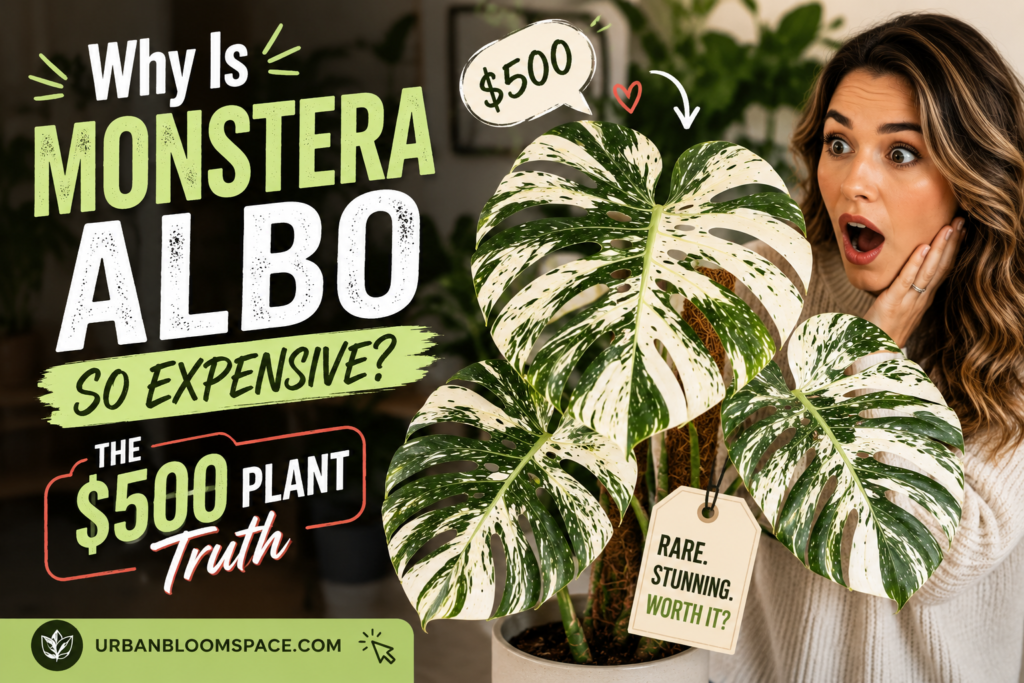
You were scrolling through an online plant shop — maybe Etsy, maybe a specialty nursery — and you stopped cold.
A single houseplant. One plant. Sometimes just a cutting with two leaves. And the price: $150. $300. $500. Occasionally more.
For a plant.
Your first reaction was probably disbelief. Maybe a little indignation. Because you can buy a fully grown pothos at your local garden center for $6, and it trails beautifully, and it never asks for anything except occasional water. So what on earth makes a monstera albo — which is, technically, the same species as the $25 monstera at Home Depot — worth five hundred dollars?
The answer is not hype. It’s not influencer culture (though that hasn’t hurt). It’s not a coordinated scheme by rare plant sellers to fleece enthusiasts.
The answer is a genuinely fascinating combination of plant biology, supply economics, shipping logistics, and collector psychology that makes the monstera albo price not just explainable but — when you understand all the pieces — completely logical.
By the end of this article, you’ll understand exactly why monstera albo costs what it costs, what determines whether a specific plant is worth more or less than average, how the price has shifted over time, and where to find one at a fair price if you decide to buy.
📌 Save this to your rare plants board on Pinterest — this is the article you share when someone asks why you spent that much on a plant.
What Is Monstera Albo, Exactly?
Before the economics, a quick grounding — because understanding the biology is essential to understanding the price.
Monstera albo is the common name for Monstera deliciosa ‘Albo Variegata’ — a variegated cultivar of the extremely common Swiss cheese plant. The standard monstera deliciosa is one of the most widely grown, easily propagated, and inexpensive houseplants in the world. You can find it at IKEA, Home Depot, and virtually every garden center in the US for $15–$40.
The albo version of the same species looks almost nothing like its common counterpart.
Where a standard monstera is uniformly dark green, monstera albo has dramatic sections of pure, clean white on its leaves — sometimes half a leaf, sometimes large irregular sectors, sometimes striking marble-like patterns running through the green. The contrast is extreme, architectural, and visually striking in a way that photographs beautifully and commands attention in person.
That white variegation is the entire story behind the price — and everything about why monstera albo is expensive traces back to what causes it and why it can’t be easily replicated.
The Biology of White: Why Variegation Is Rare and Unpredictable
The white sections in a monstera albo leaf are caused by the complete absence of chlorophyll in those cells.
Chlorophyll is the pigment responsible for the green color in plant leaves — and, more critically, it’s the molecule that captures light energy and drives photosynthesis. Cells without chlorophyll are white or cream-colored, but they cannot produce energy from light. They are, from a functional biology standpoint, inert passengers on an otherwise photosynthetically productive leaf.
How this variegation happens: Monstera albo is what botanists call a chimeric mutant — a plant in which two genetically distinct cell populations exist side by side. One population has normal chlorophyll-producing cells (green). The other carries a mutation that prevents chlorophyll production (white). These two cell lines coexist in the plant’s growing tissue but remain genetically separate — they don’t merge, and neither overtakes the other completely.
This is not a disease, a deficiency, or damage. It is a stable (though variable) genetic anomaly that produces one of the most dramatic visual effects in the plant kingdom.
Why this makes commercial propagation nearly impossible:
Chimeric variegation cannot be reproduced through tissue culture — the laboratory technique that allows nurseries to produce thousands of genetically identical plants from a single specimen. Tissue culture works by growing plants from individual cells. But when you isolate individual cells from a chimeric plant, you get either a fully green plant (from a chlorophyll-producing cell) or a fully white plant (from a non-chlorophyll-producing cell). You cannot reliably capture the chimeric condition — the interleaved coexistence of both cell types — in a single isolated cell.
This single biological fact is the foundation of the entire monstera albo price story. Every albo plant in existence had to be propagated the old-fashioned way: by physically cutting a stem from an existing albo plant, allowing it to root, and growing it out. One cutting at a time. One plant at a time.
💡 Quick tip: This is also why monstera albo variegation can be unpredictable even on the same plant. Different growth points carry slightly different ratios of the two cell populations — which is why one growth point might consistently produce beautifully balanced 50/50 leaves while another on the same plant produces mostly green ones. The chimeric nature of the variegation means no two leaves ever look identical, and no grower can guarantee what the next leaf will look like.
Why Is Monstera Albo So Expensive? The 6 Real Reasons
Reason 1: It Can Only Be Propagated by Hand, One Cutting at a Time
This is the core supply constraint that everything else builds on.
A commercial nursery that wants to produce 10,000 pothos plants can take a handful of healthy specimens, use tissue culture to multiply those specimens into 10,000 genetically identical plants in a laboratory, and have market-ready plants within weeks. The marginal cost of each additional plant drops dramatically as scale increases.
A nursery that wants to produce 10,000 monstera albo plants cannot do this. Each new plant requires a physical stem cutting from an existing albo plant. Each cutting must be taken carefully — not too many from any one plant, or you risk weakening the mother plant. Each cutting must be rooted, which takes 4–8 weeks. Each rooted cutting must be grown out into a saleable plant, which takes additional months.
The math: A single healthy albo mother plant, carefully managed, might yield 4–6 cuttings per year without compromising the plant’s health. Each cutting produces one new plant. To produce 1,000 albo plants per year, a nursery needs to maintain and care for approximately 200 healthy mother plants — each of which itself requires space, light, water, labor, and ongoing care.
The production cost per plant is inherently high and cannot be meaningfully reduced by scale. This is fundamentally different from virtually every other common houseplant on the market.
Reason 2: Growth Is Slow — Very Slow
Even after a cutting is successfully rooted, the journey to a saleable plant is a long one.
Standard monstera deliciosa grows quickly — in good conditions, a new leaf every 4–6 weeks, with vines extending aggressively. A nursery can take a cutting, root it, and have a market-ready plant in 3–4 months.
Monstera albo grows at roughly half that speed. The white sections of the leaves cannot photosynthesize — which means the plant is running on less energy than a fully green plant of the same size. Less energy means slower growth, smaller new leaves, and a longer runway from cutting to saleable plant.
A rooted albo cutting with one leaf takes approximately 6–12 months to grow into a plant with 3–4 leaves that a buyer would consider worth purchasing as an established specimen. During those 6–12 months, the nursery is paying for space, utilities, labor, water, and nutrients — all of which are factored into the final price.
⚠️ Important context: This slow growth is not a flaw. It’s the biological reality of a plant with reduced photosynthetic capacity. It’s also part of why each new leaf on an albo feels like an event rather than a routine occurrence — because it genuinely is. A new albo leaf represents 6–10 weeks of the plant’s energy investment. That matters when you’re evaluating the price.
Reason 3: Propagation Success Is Not Guaranteed
Not every cutting roots successfully. Not every rooted cutting produces variegated growth. And not every variegated plant produces the kind of dramatic, marketable variegation that justifies premium pricing.
Cutting failure rate: Depending on conditions, humidity control, and the health of the mother plant, a meaningful percentage of albo cuttings simply don’t root successfully. Unlike pothos or philodendron cuttings — which root so reliably that propagation failure is almost unknown — albo cuttings carry real failure risk. Every failed cutting represents wasted input costs (space, time, effort) with zero output.
Variegation unpredictability: Even when a cutting roots successfully and grows into a plant, the resulting variegation pattern is not guaranteed. A cutting taken from a growth point that was producing well-balanced 50/50 leaves might produce heavily green or heavily white leaves in the next growth cycle. Plants that revert heavily toward green lose most of their market value — they’re technically albo, but they look almost like standard monsteras. Plants that produce predominantly white growth look spectacular but are energetically fragile.
The production of a consistently, beautifully variegated monstera albo specimen requires the right mother plant, the right cutting selection, the right growing conditions, and a significant element of luck. That uncertainty is priced into every plant you see for sale.
Reason 4: Shipping a Rare Houseplant Is Expensive and Risky
The majority of monstera albo purchases in the US happen online — because the supply of quality plants is spread across a relatively small number of specialist growers, and local availability is limited outside of major metropolitan areas.
Shipping a live tropical plant with large, fragile, partially white leaves across the country introduces its own set of costs and risks:
Packaging requirements: Albo plants require careful packaging — stems supported, leaves individually wrapped or secured, root ball protected, and insulation added for cold-weather shipping. This is not a $3 box-and-bubble-wrap situation. A properly packaged albo cutting requires 15–30 minutes of careful packing labor and $8–$25 in materials.
Shipping speed: Live tropical plants cannot travel slowly. Standard ground shipping that takes 5–7 days exposes a tropical plant to temperature fluctuations, darkness, and ethylene gas accumulation (from the plant’s own metabolism in a sealed box) that can cause leaf damage, yellowing, and root stress. Most responsible albo sellers use 2-day or overnight shipping — which costs $30–$80 or more depending on box weight and destination.
Arrival guarantee costs: Responsible sellers offer arrival guarantees — if the plant arrives dead or severely damaged, they replace it or refund the purchase. That guarantee represents real financial risk to the seller. A $300 albo that dies in transit costs the seller the plant value, the replacement plant value, and the shipping costs for both. That liability is factored into the price of every plant sold with a guarantee.
The total shipping cost reality: By the time a $200 albo plant is properly packaged, shipped overnight, and covered by an arrival guarantee, the seller has spent $50–$100 in shipping-related costs on top of the production cost of the plant itself.
Reason 5: Demand Genuinely Outstrips Supply
The supply constraints above would push albo prices up even in a world of moderate demand. In the actual world of social media-driven plant culture, the demand side of the equation is extraordinary.
How social media creates compressed demand: A single viral Instagram post or TikTok video featuring a monstera albo can generate thousands of new people searching for the plant within 24 hours. Each of those people enters a market where supply increases at the rate of one cutting per mother plant per several months. The demand spike is instantaneous; the supply response is measured in seasons.
The collector culture premium: Monstera albo exists at the intersection of two powerful consumer psychology forces — scarcity value and aesthetic prestige. Rare plants carry a status signal within the plant community that genuinely affects willingness to pay. A beautifully variegated albo on a shelf communicates something about the owner’s taste, dedication, and plant knowledge that a row of pothos doesn’t — and the market prices that signal accordingly.
The Instagram and Pinterest visibility cycle: The more photos of stunning monstera albo plants appear on social media, the more people want one. The more people want one, the higher prices go. Higher prices make the plant feel more desirable (scarcity = value in human psychology). The cycle reinforces itself continuously, and it has been running since approximately 2018.
Reason 6: The Seller Carries Significant Risk and Investment
The final piece of the monstera albo cost equation is often invisible to buyers: the accumulated risk and investment that every legitimate seller carries.
A specialist who sells quality monstera albo plants has typically:
- Spent years sourcing, growing, and maintaining a collection of healthy mother plants
- Lost a meaningful percentage of cuttings and plants to failed propagations, pests, disease, and shipping accidents
- Invested in appropriate growing infrastructure — lighting, humidity control, heating in winter
- Built the knowledge to recognize quality variegation, select optimal cuttings, and maintain plant health through the slow growing process
- Developed the packaging and shipping expertise to get live plants to buyers successfully
That accumulated expertise, infrastructure, and absorbed failure cost is part of what you’re paying for when you buy from a reputable albo seller. The $300 price tag on a beautiful established albo is not purely the cost of that one plant — it’s the cost of the production system that made that plant possible.
How Much Does a Monstera Albo Cost? The 2026 Price Guide
Monstera albo prices peaked dramatically in 2021–2022, driven by pandemic-era houseplant demand and social media attention. Since then, the market has partially normalized — but prices remain high relative to nearly all other houseplants because the biological supply constraints haven’t changed.
Here is what you can expect to pay for monstera albo in 2026:
Unrooted node (stem section with one node, no leaves, no roots)
- What it is: A single stem section capable of producing a new plant if successfully rooted
- Price range: $25–$80
- Who it’s for: Experienced plant parents comfortable with propagation who want the lowest entry price and accept the risk of rooting failure
- Reality check: An unrooted node is not a plant yet. It requires 4–8 weeks of careful rooting management before you know if it’s viable, then many more months of growing before it produces a meaningful leaf
Rooted cutting with 1 leaf
- What it is: A single stem with established roots and one variegated leaf
- Price range: $80–$200
- Who it’s for: Intermediate plant parents who want a real plant with confirmed roots but can accept slow, early-stage growth
- Best value tier: You’re paying for confirmed viability but haven’t yet paid a premium for established size
Established plant with 2–4 leaves
- What it is: A plant that has already proven its ability to grow and produce multiple leaves in a home environment
- Price range: $150–$400
- Who it’s for: Most buyers — this tier provides confirmed variegation across multiple leaves, established root system, and a plant that’s past the most vulnerable early stages
- The sweet spot: Enough investment to confirm quality without the maximum premium of a large specimen
Large established specimen with 5+ leaves
- What it is: A mature or maturing albo plant with substantial size, established climbing support, and demonstrated variegation history
- Price range: $300–$800+
- Who it’s for: Collectors who want immediate dramatic impact and are willing to pay the premium for proven quality and size
Highly variegated or exceptionally patterned specimens
- What it is: Plants with unusually dramatic variegation — half-moon leaves, exceptionally balanced 50/50 patterns, or rare growth forms
- Price range: $400–$2,000+
- Who it’s for: Serious collectors who place a premium on exceptional individual specimens
- The reality: These prices reflect the lottery-like rarity of consistent, exceptional variegation — even experienced growers see these patterns only occasionally
What Makes One Monstera Albo Worth More Than Another?
Not all monstera albo plants are priced equally, and understanding what drives relative value helps you assess whether a specific listing is priced fairly.
Variegation pattern and distribution The single biggest value driver. Plants with large, evenly distributed white sections — especially the dramatic “half-moon” pattern where an entire half of a leaf is pure white — command significantly higher prices than plants with modest speckle variegation or predominantly green leaves with small white sectors. More white, more dramatically distributed = higher price.
Leaf size Larger leaves indicate a more established, better-cared-for plant. A monstera albo with 8-inch leaves is worth more than a plant of similar leaf count with 4-inch leaves because the larger leaves represent more time, more growth, and more demonstrated plant health.
Consistency across multiple leaves A plant that has produced three consecutive beautifully variegated leaves is worth more than a plant that produced one great leaf and two mostly-green ones. Consistency suggests the specific growth point on that plant reliably produces balanced variegation — which is far from guaranteed.
Root system health For cuttings specifically, the size and health of the root system affects price. Thick, white, established roots versus minimal hairline roots represent meaningfully different levels of plant viability and buyer risk.
Number and health of nodes More nodes on a cutting mean more potential growth points, which means more future leaves and more future propagation opportunities. A cutting with three nodes is more valuable than a cutting with one node, all else being equal.
Will Monstera Albo Prices Ever Come Down Significantly?
This is the question most prospective buyers are really asking, and it deserves a direct answer.
The honest projection: Monstera albo prices have moderated from their 2021–2022 peak and will likely continue to moderate gradually. But a dramatic price collapse — the kind that brought Thai constellation from $300+ to $60–$150 as tissue culture production scaled — is unlikely for albo.
Here’s why: Thai constellation prices dropped because tissue culture production scaled and flooded the market with supply. That path is biologically closed for monstera albo chimeric variegation. Unless a reliable tissue culture method for chimeric variegation is developed — which researchers have been attempting without success for years — the supply constraint is structural and permanent.
What could drive meaningful price drops:
- A significant global expansion of albo mother plant collections and hand propagation operations (possible, but slow)
- A scientific breakthrough in chimeric tissue culture (possible, but not imminent as of 2026)
- A major shift in consumer taste away from variegated aroids (possible, but no current signals)
What this means for buyers: If you want a monstera albo and can afford a fair-market specimen, waiting 12–18 months is unlikely to save you more than 10–20% and will cost you 12–18 months of enjoyment. The plant you buy today at fair market value is unlikely to feel like a significant overpayment in retrospect — unlike the peak 2021–2022 prices, which did moderate meaningfully.
Where to Find Monstera Albo for Sale at a Fair Price
Knowing what fair market price looks like — and where to find legitimate plants — protects you from both overpaying and from purchasing misrepresented plants.
Amazon specialty shops The largest marketplace for rare monstera albo plants in the US. Look for shops with 200+ reviews, recent buyer photos, and sellers who can confirm the species name. Price-compare across multiple listings before buying. Buy Now
US rare plant Facebook groups Groups like “US Aroid Sales, Trades and Auctions” allow peer-to-peer sales directly from collectors. Prices are often better than retail, and you can ask detailed questions before committing. The community generally self-polices against misrepresented plants.
Local plant swaps and events Buying in person eliminates most misrepresentation risk because you can inspect the plant before money changes hands. Major US cities have active plant swap communities — worth checking before defaulting to online purchasing.
Specialty online nurseries A growing number of US nurseries focus on rare aroids and carry verified monstera albo plants with arrival guarantees and clear species labeling. Higher prices than peer-to-peer sales, but more buyer protection.
What to avoid:
- Prices dramatically below market (an unrooted node for $10, a rooted cutting with a leaf for $30 — these are red flags in 2026)
- Sellers who won’t confirm the scientific name
- Plants with uniformly pink or neon-bright coloring (potential dye)
- Listings using stock photos or photos that appear on multiple different seller accounts
The Complete Monstera Albo Care Toolkit
If you decide to buy, have these tools ready before the plant arrives — particularly if you’re spending serious money on an established specimen:
1. Moisture Meter The single most important tool for monstera albo care. Overwatering is the most common way expensive albos die. $10–$15 · Buy Now
2. Full-Spectrum LED Grow Light If your space doesn’t have genuinely bright indirect light for 6–8 hours daily, this is essential before the plant arrives. $35–$80 · Buy Now
3. Chunky Aroid Potting Mix Better drainage than standard potting mix — reduces the root rot risk that disproportionately affects albo due to its slower water use. $15–$25 · Buy Now
4. Ultrasonic Humidifier Maintains 60–70% humidity that protects white sections from browning. $35–$65 · Buy Now
5. Moss Pole or Coco Coir Climbing Support Enables the large, fenestrated growth that makes mature albos so spectacular. $15–$35 · Buy Now
6. Balanced Liquid Aroid Fertilizer Half-strength, once monthly during growing season. $12–$20 · Buy Now
Your Monstera Albo Price Questions Answered
Q: Is a monstera albo a good investment that will hold its value?
A: With important caveats — possibly. Monstera albo plants have held their value better than most other rare plants that experienced the 2021–2022 demand surge, precisely because the supply constraint is structural rather than temporary. A well-cared-for, beautifully variegated established albo has historically maintained and sometimes appreciated in value over time. That said, treating a houseplant purely as a financial investment is risky — care failures, pest damage, or market shifts can affect value unpredictably. Buy because you love it. The value retention is a pleasant secondary benefit, not a guaranteed return.
Q: Why does the same monstera albo cost so much more from one seller than another?
A: Several factors legitimately drive price differences between sellers: variegation quality (more dramatic variegation = higher price), plant size and maturity, root system development, and the seller’s overhead costs (a commercial nursery with high overheads prices differently than a home grower with lower costs). Be cautious of prices dramatically below market — they often signal either misrepresented plants or plants in poor health. But prices somewhat above market from established shops with strong reviews may reflect genuinely superior quality.
Q: How much does a monstera albo cutting cost vs a full plant?
A: In 2026, an unrooted node cutting costs $25–$80. A rooted cutting with one leaf costs $80–$200. A small established plant with 2–3 leaves costs $150–$300. A larger established specimen with 5+ leaves can cost $300–$600 or more. The price step-up from unrooted node to established plant reflects both the production time invested and the risk you’re absorbing by purchasing at an earlier versus later stage of development.
Q: Why does variegated monstera albo cost so much more than standard monstera?
A: Standard monstera deliciosa can be produced through tissue culture at massive scale — a single facility can produce tens of thousands of plants per year, driving the cost per plant down to $15–$40. Variegated monstera albo cannot be tissue-cultured due to its chimeric nature — every plant requires manual hand propagation, one cutting at a time. The production cost differential between these two methods is enormous, and it’s reflected directly in the retail price difference.
Q: Is there a cheaper alternative that looks similar to monstera albo?
A: For the high-contrast white variegation aesthetic specifically — not really. Monstera Thai constellation offers a different (softer, cream-speckled) variegation at lower prices ($50–$200). Rhaphidophora tetrasperma ‘Variegata’ offers a smaller-scale variegated leaf at lower prices. But nothing quite replicates the dramatic, high-contrast pure white sections of a true albo. If the albo aesthetic is what moves you, there isn’t a meaningful substitute at a significantly lower price point that delivers the same visual impact.
The $500 Plant That Makes Complete Sense
Here’s the thing about the monstera albo price that becomes clear once you understand all the moving parts:
It isn’t a scam. It isn’t hype inflating a worthless product. It isn’t a conspiracy among rare plant sellers to extract money from enthusiasts.
It is the honest market price of a plant that is genuinely, irreducibly difficult to produce at scale — combined with demand that outpaces supply by a significant margin and shows no signs of collapsing. The biology drives the supply. The aesthetics drive the demand. The price sits at the intersection of those two realities.
When you understand that a beautifully variegated monstera albo with three leaves represents a mother plant’s years of careful maintenance, a successful cutting selection, 6–12 months of slow growth through two seasons, packaging and overnight shipping costs, and an arrival guarantee — $300 starts to feel not just understandable but almost reasonable.
Whether it’s the right plant for your budget and your life is a completely separate question. But the price makes sense. And now you know exactly why.
📌 Found this helpful? Save it to your rare plants board on Pinterest — and share it the next time someone asks why anyone would spend $500 on a houseplant.
Also read:
- Monstera Albo Care: Why This Rare Plant Is Worth the Hype
- Monstera Albo vs Thai Constellation: Which Rare Monstera Should You Buy?
- Thai Constellation Monstera Care Guide for Beginners
- Best Rare Houseplants Worth Buying in 2026 — Ranked by Care Ease and Aesthetic Payoff
- How to Make Your Monstera Grow Bigger Leaves: Light, Humidity and Fertilizer Guide
Want a free Rare Plant Buyer’s Checklist? A printable guide covering what to look for, red flags to avoid, and fair price ranges for the top rare houseplants in 2026. Download Now