
Monstera Albo vs Thai Constellation: Which Rare Monstera Should You Buy?
You’ve done the research. You’ve spent more time than you’d like to admit scrolling through rare plant shops, Etsy listings, and Instagram accounts dedicated entirely to variegated monsteras.
And now it comes down to two plants.
Monstera albo. Thai constellation. Both stunning. Both expensive. Both capable of completely transforming the aesthetic of a room with a single well-placed leaf.
But they are not the same plant — and the one that’s right for you depends on things most comparison articles never ask about: your light situation, your experience level, your budget, your relationship with plant anxiety, and honestly, which one makes your heart beat faster when you look at it.
This is the honest, detailed comparison that helps you make the call with confidence — so you spend your money once, on the right plant, and don’t spend the next six months wondering if you chose wrong.
📌 Save this to your rare plants board on Pinterest before you decide — you’ll want to reference it when you’re ready to buy.
Meet the Contestants: What Each Plant Actually Is
Before the comparison, a quick grounding in what makes each plant distinct — because the differences run deeper than aesthetics.
Monstera Albo (Monstera deliciosa ‘Albo Variegata’)
Monstera albo is a chimeric variegated cultivar of the common monstera deliciosa. Its variegation is caused by a spontaneous genetic mutation — a sector of cells in the plant lost the ability to produce chlorophyll, creating the dramatic, high-contrast white sections that make albo so visually striking.
The critical word here is chimeric. The variegation exists as genetically distinct cell sectors within the plant — and those sectors don’t always distribute the same way in new growth. That’s why every albo leaf looks different from the last, why some leaves can come in nearly all white, and why some growth points can revert toward green.
Every monstera albo plant on the market today was propagated by hand from a cutting. There is no reliable tissue culture method for reproducing chimeric variegation. This is the fundamental constraint that keeps albo supply limited and prices high.
Thai Constellation (Monstera deliciosa ‘Thai Constellation’)
Thai constellation was developed in a nursery in Thailand through deliberate tissue culture — a laboratory technique that reproduces plants from individual cells under controlled conditions. The variegation was introduced and stabilized at the cellular level during this process, meaning every Thai constellation plant carries stable, predictable variegation genetics.
The practical result: Thai constellation can be produced at scale. A tissue culture facility can produce thousands of genetically identical, reliably variegated plants. This is why Thai constellation has become significantly more accessible and more affordable over the past several years — and why its variegation never reverts.
The Visual Difference: Albo Leaves vs Constellation Leaves
This is where the two plants diverge most visibly — and where personal aesthetic preference should play a significant role in your decision.
Monstera albo leaves: High-contrast, dramatic, unpredictable. The white sections are pure white — sometimes half a leaf, sometimes a large irregular sector, sometimes a striking marbled pattern running through the green. No two leaves look the same. The contrast between the deep, waxy green and the clean white is extreme and architectural. Albo leaves photograph extraordinarily well and have a presence that stops people mid-sentence in person.
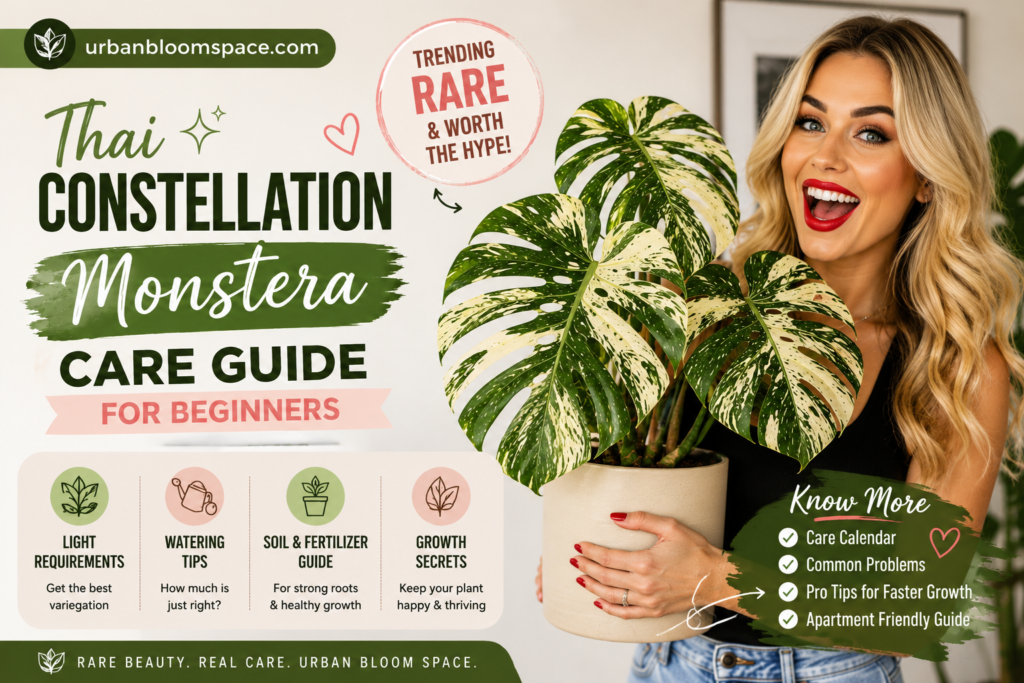
Thai constellation leaves: Softer, more diffused, consistently patterned. The cream-to-pale-yellow variegation appears as speckles, brushstrokes, and patches distributed across the green leaf — creating the star-field effect that gives the plant its name. The pattern is beautiful and sophisticated but less visually aggressive than albo’s high-contrast white. Thai constellation leaves are more consistently attractive — you know roughly what each new leaf will look like before it unfurls.
The honest aesthetic verdict: Albo is the drama queen. Thai constellation is the quietly stunning one. Albo commands a room; Thai constellation rewards closer inspection. Neither is objectively better — they appeal to genuinely different aesthetic sensibilities.
💡 Quick tip: Look at photos of each plant in real apartment settings — not just studio shots with perfect lighting — before deciding. Albo’s high contrast holds up in most environments. Thai constellation is especially beautiful in warm, earthy, cottagecore or Japandi interiors where its softer coloring feels intentional rather than accidental.
The Full Monstera Comparison: Every Factor That Matters
Variegation Stability
| Factor | Monstera Albo | Thai Constellation |
|---|---|---|
| Variegation type | Chimeric mutation | Tissue culture stable |
| Reversion risk | Moderate — can produce heavily green leaves | Very low — essentially does not revert |
| All-white leaf risk | Present — drains plant energy | Absent |
| Leaf-to-leaf consistency | High variability | High consistency |
| Variegation in propagated cuttings | Variable — depends on which cell sectors are in the cutting | Stable — cuttings reliably produce variegated plants |
What this means for you: If variegation anxiety — worrying about whether the next leaf will be green, or all-white, or beautifully balanced — sounds exhausting rather than exciting, Thai constellation is your plant. If the unpredictability sounds thrilling and you want every leaf to be a surprise, albo rewards that mindset.
Price: What You’re Actually Paying For in 2026
Monstera albo (2026 market):
- Unrooted node (cutting with no roots yet): $40–$120
- Rooted cutting with 1 leaf: $100–$250
- Established plant with 3–5 leaves: $200–$600+
- Highly variegated or unusually patterned specimens: $400–$1,000+
Thai constellation (2026 market):
- Small starter plant (2–3 leaves): $50–$120
- Medium established plant (4–6 leaves): $100–$200
- Large established plant (6+ leaves, on pole): $150–$350
Why the price gap exists: Albo can only be propagated by hand, one cutting at a time. Thai constellation can be produced through tissue culture at scale. As Thai constellation production has scaled globally since 2020, prices have dropped significantly. Albo prices have moderated from their 2021–2022 peak but remain higher due to the irreducible supply constraint.
The price trajectory: Thai constellation prices are likely to continue moderating gradually as more nurseries adopt tissue culture production. Albo prices are more stable because the supply limitation is structural, not just a production lag. Buying albo now versus in two years is unlikely to represent significant savings. Buying Thai constellation now versus waiting may save you money if prices continue to drop.
⚠️ Common mistake: Choosing albo purely because it’s more expensive, assuming price equals quality or beauty. For many people — especially beginners — Thai constellation is the more satisfying plant to own because it’s more predictable, more forgiving, and more consistently beautiful. Price reflects supply constraints, not which plant will make you happier.
Care Difficulty: The Honest Comparison
This is the most important section for most buyers — and the one where honest guidance matters most.
Monstera albo care difficulty: Moderate to High
- Needs more light than Thai constellation because pure white sections are completely non-photosynthetic
- More sensitive to overwatering due to reduced overall photosynthetic capacity
- White sections brown more easily in low humidity or with any direct sun exposure
- Variegation management requires active decision-making: when to prune green growth, how to respond to all-white growth
- Slower to recover from mistakes because of reduced energy production
- Best for: Plant parents with at least 12 months experience successfully keeping tropical plants alive, who can honestly assess and provide adequate light, and who enjoy active plant management
Thai constellation care difficulty: Moderate
- Needs bright indirect light — more than a standard monstera, but the same threshold as albo
- Slower growing than standard monstera but more predictable than albo
- Stable variegation means no active variegation management decisions
- More forgiving of occasional care lapses than albo
- Cream sections still sensitive to low humidity and direct sun, but less acutely so than albo’s pure white sections
- Best for: Plant parents ready to step up from beginner plants into rare plant territory, who want a showstopper plant without maximum complexity
The experience level recommendation:
| Your experience | Recommended plant |
|---|---|
| Less than 6 months of plant care | Neither — build experience with standard monsteras, pothos, and snake plants first |
| 6–12 months, tropicals alive and thriving | Thai constellation — excellent first rare monstera |
| 12+ months, standard monstera thriving | Either — choose based on aesthetic preference and budget |
| Experienced rare plant collector | Albo — if the unpredictability excites you rather than stresses you |
Growth Rate: Managing Expectations
Neither plant will grow as fast as a standard monstera deliciosa — variegation comes with a growth speed trade-off because reduced green leaf area means reduced energy production. But the two plants grow at different speeds relative to each other.
Monstera albo growth rate: Slow. Expect a new leaf every 6–10 weeks in good conditions during the growing season. Leaves are large and dramatic but take time to produce. In lower light or winter, new growth can stall for months.
Thai constellation growth rate: Slow to moderate. Slightly faster than albo in comparable conditions because the distributed cream speckle pattern leaves more total green leaf surface than albo’s large white sections. Expect a new leaf every 4–8 weeks in good conditions.
Managing the slow growth mindset: Both plants will test your patience if you’re accustomed to fast growers. The reframe that most successful rare plant collectors use: each new leaf is an event, not just a growth increment. A new albo or Thai constellation leaf that has been building for 6–8 weeks unfurling over several days is genuinely exciting in a way that a pothos leaf appearing every week never quite is. Lean into the slower pace.
Propagation: Growing Your Investment
Monstera albo propagation:
- Method: Stem cutting with at least one node
- Rooting medium: Water, sphagnum moss, or LECA
- Rooting time: 4–8 weeks in warm conditions
- Variegation in cuttings: Variable — depends on which cell sectors are present in the cutting. A cutting from a growth point that recently produced heavily variegated leaves is more likely to produce variegated offspring than a cutting from a growth point that produced mostly green leaves
- Propagation value: High — well-variegated albo cuttings can sell for $60–$200+
Thai constellation propagation:
- Method: Stem cutting with at least one node
- Rooting medium: Water, sphagnum moss, or LECA
- Rooting time: 3–6 weeks in warm conditions
- Variegation in cuttings: Stable — all cuttings reliably produce variegated plants
- Propagation value: Moderate — Thai constellation cuttings are more widely available and sell for less than albo cuttings, but still represent meaningful value
For the plant parent interested in eventually propagating and trading: Albo cuttings carry higher individual value but are harder to produce reliably variegated. Thai constellation cuttings are reliably variegated but worth less individually. Both are worth propagating — the economics just differ.
Affiliate Picks: Where to Buy Each Plant in 2026
Finding legitimate plants at fair prices requires knowing where to look. Here are the most reliable sources for each — organized by plant type.
For monstera albo:
1. Established Etsy Specialty Shops The best source for legitimate albo plants at fair market prices. Look for shops with 200+ reviews, clear photos showing multiple growth stages, and sellers who can confirm the species as Monstera deliciosa ‘Albo Variegata’. Avoid shops with stock photos or suspiciously low prices (under $60 for any rooted albo is a significant red flag in 2026). Price range: $100–$400 depending on size and variegation [ADD TOP-RATED ETSY SHOP AFFILIATE LINK]
2. Rare Plant Facebook Groups and Local Swaps The US rare plant community on Facebook is large and active. Groups like “US Aroid Sales, Trades and Auctions” allow you to buy directly from collectors — often at better prices than retail shops, with the ability to see more detailed photos and ask questions directly. Buying locally eliminates shipping risk for a plant this expensive. Price range: $80–$300 depending on size and region.
3. Specialty Online Nurseries A growing number of US-based specialty nurseries sell verified rare aroids with arrival guarantees and clear species labeling. These tend to have higher prices than peer-to-peer sales but offer more buyer protection. Price range: $150–$500+
For Thai constellation:
1. Steve’s Leaves / Rare Plant Fairy / Josh’s Frogs (example category — confirm current stock) Several established US online nurseries now carry Thai constellation regularly due to increased tissue culture availability. These shops offer buyer protection, arrival guarantees, and verified species labeling. Price range: $60–$200
2. Costa Farms Rare Plant Collection Costa Farms has been expanding into rare and collector plant lines, including Thai constellation, available through major retailers. Less expensive than specialty shops and more accessible, though selection is more limited. Price range: $50–$120
3. Etsy Verified Sellers Same guidance as albo — look for shops with extensive review histories, clear photos, and confirmed species labeling. Thai constellation is more widely available on Etsy than albo, which means more legitimate options but also more misrepresented plants. Price range: $50–$180
4. Local Plant Shops and Garden Centers Thai constellation has become common enough that well-stocked independent plant shops in major US cities now carry it regularly. Buying locally lets you inspect the plant before purchasing and eliminates shipping stress — worth checking your local options before buying online. Price range: $60–$250 depending on location and size
💡 Quick tip: For any online rare plant purchase, ask the seller for a photo of the plant taken within 48 hours of shipping — not the stock photo used in the listing. This confirms you’re getting the actual plant shown, not a less attractive specimen from the same batch. Legitimate sellers will always accommodate this request. Those who won’t are a red flag.
What to Look for When Buying: Red Flags and Green Lights
Red flags that should stop you from purchasing:
- Seller cannot confirm the scientific name (‘Albo Variegata’ or ‘Thai Constellation’ specifically)
- Photos look like stock images or appear on multiple different seller listings
- Price is dramatically below market (under $50 for any rooted Thai constellation with a leaf; under $100 for any rooted albo with a leaf in 2026)
- Uniformly pink or neon-bright variegation — this may indicate a dyed plant or a misrepresented variety
- Seller account is very new with few or no reviews
- No clear arrival or DOA (dead on arrival) guarantee policy for shipped plants
Green lights that indicate a trustworthy purchase:
- Scientific name confirmed in writing
- Recent photos of the specific plant, showing multiple growth stages
- Clear return or arrival guarantee policy
- Extensive review history with photos from previous buyers
- Seller is responsive, knowledgeable, and can answer care questions accurately
- Plant is shown with visible roots (for cuttings) or established in appropriate well-draining soil
Side-by-Side Summary: Monstera Albo vs Thai Constellation
| Factor | Monstera Albo | Thai Constellation |
|---|---|---|
| Aesthetic | High-contrast, dramatic white | Soft cream speckle constellation pattern |
| Variegation stability | Unstable — can revert or go all-white | Stable — consistent across all growth |
| Price (2026) | $100–$600+ | $50–$350 |
| Care difficulty | Moderate to high | Moderate |
| Growth rate | Slow (6–10 weeks/leaf) | Slow-moderate (4–8 weeks/leaf) |
| Best for | Experienced plant parents | Beginners to rare plants |
| Propagation value | Higher per cutting | Lower per cutting but reliable |
| Availability | Limited — cuttings only | Increasing — tissue culture |
| Forgiveness of mistakes | Lower | Higher |
| Anxiety level to own | Higher (variegation unpredictability) | Lower (predictable and stable) |
The Decision Framework: 5 Questions to Find Your Answer
Stop scrolling through photos for a moment and answer these five questions honestly. Your answers will tell you which plant is genuinely right for you right now.
Question 1: What does your light situation actually look like?
- If you have a genuine south or east-facing window with several hours of bright indirect light available: either plant can work
- If your space is moderate to low light and you’re not prepared to invest in a grow light: wait on both until your light situation improves. Neither plant will thrive without adequate light, and an expensive plant in poor light is money wasted
Question 2: How long have you been successfully keeping tropical plants alive?
- Under 6 months: build experience first with standard monsteras, pothos, and snake plants
- 6–12 months with tropicals thriving: Thai constellation is your plant
- 12+ months with confident care knowledge: choose based on preference and budget
Question 3: How do you feel about variegation unpredictability?
- The idea of not knowing what the next leaf will look like sounds exciting and intriguing: albo is made for you
- The idea of spending $200+ and then watching a leaf come in mostly green sounds genuinely stressful: Thai constellation is your plant
Question 4: What is your honest budget?
- Under $150: Thai constellation — you can get a beautiful, established plant in this range
- $150–$300: either plant — a rooted albo cutting or a medium Thai constellation
- $300+: either — you have access to impressive specimens of both
Question 5: Which one do you keep coming back to look at? This is not a trivial question. The plant that makes you stop scrolling, the one you’ve saved more photos of, the one you think about when you’re doing something completely unrelated to plants — that’s probably the one that will bring you more joy to actually own. Buy the one that moves you, not the one you think you should want.
What You’ll Need for Either Plant: The Shared Shopping List
Regardless of which rare monstera you choose, the care toolkit is essentially the same. Here’s what to have ready before your plant arrives:
1. Moisture Meter Essential for both plants. Takes the guesswork out of watering and protects against the most common killer — overwatering. Insert to 2–3 inch depth before every watering decision. $10–$15 · Buy Now
2. Chunky Aroid Potting Mix Purpose-built for aroids with excellent drainage. Far better than standard potting mix for both plants. $15–$25 · Buy Now
3. Ultrasonic Humidifier Both plants have white or cream sections that are vulnerable to low humidity. Maintaining 55–65% humidity protects those sections and supports healthy unfurling. $35–$65 · Buy Now
4. Full-Spectrum LED Grow Light (if needed) Both plants need bright indirect light. If your space doesn’t have it naturally, this is essential before either plant arrives. $35–$80 · Buy Now
5. Moss Pole or Coco Coir Climbing Support Both plants produce their most impressive, large, fenestrated leaves when given vertical climbing support. Buy one taller than you currently need. $15–$35 · Buy Now
6. Balanced Liquid Aroid Fertilizer Half-strength, once monthly during growing season, for both plants. $12–$20 · Buy Now
Total setup cost estimate: $80–$200 on top of plant cost, depending on what you already own. Factor this into your budget when comparing plant prices — a $60 Thai constellation with a full care kit is a larger investment than the plant price alone suggests.
Your Monstera Comparison Questions Answered
Q: Is monstera albo harder to care for than Thai constellation?
A: Yes — meaningfully so, though both plants share the same core care requirements. The key differences are that albo’s pure white sections are more vulnerable to humidity and light issues than Thai constellation’s cream speckle pattern, albo requires active variegation management (deciding when to prune green growth or all-white growth) that Thai constellation doesn’t, and albo is more sensitive to overwatering because its larger white sections leave less total green leaf surface for energy production. If you’ve never kept a rare monstera before, Thai constellation is the more forgiving starting point.
Q: Will Thai constellation prices keep dropping?
A: Almost certainly yes — gradually. Tissue culture production of Thai constellation has been scaling globally, and as more nurseries bring production online, prices will continue to moderate. The dramatic drop from 2021 peak prices to current 2026 prices has already occurred. Future drops are likely to be more gradual. If budget is a significant concern, waiting 12–18 months may save you $20–$50 on a starter plant — but you’ll also spend 12–18 months without the plant you want. The timing call is personal.
Q: Can I find either of these at a regular garden center?
A: Thai constellation increasingly yes — well-stocked independent plant shops in major US cities carry it fairly regularly, and some national retailers (Home Depot, Lowe’s in select markets) have stocked it during spring plant season. Monstera albo at a regular garden center is still rare — you’re more likely to find it at a specialty plant boutique, a plant swap, or online. Neither is as broadly available as standard monsteras, pothos, or snake plants.
Q: What if my albo produces an all-white leaf?
A: A single all-white leaf on an otherwise healthy, variegated plant is not an emergency. Leave it for now and focus on optimizing your light situation — more bright indirect light gives the plant more resources to invest in balanced variegation. If consecutive leaves continue to come in all-white, prune the most recent growth back to a node that previously produced more balanced variegation, and increase light significantly. All-white growth that persists indicates the plant’s energy budget is in deficit — the fix is always more quality light first.
Q: Is it worth buying an unrooted albo node to save money?
A: Only if you’re comfortable with propagation and willing to accept the risk that the cutting may not root successfully. Unrooted nodes are significantly cheaper than rooted cuttings — but they require rooting in sphagnum moss or LECA, adequate warmth and humidity during the rooting process, and 4–8 weeks of careful monitoring before you know if the cutting is viable. For a first rare plant purchase, a rooted cutting or established plant is worth the premium — it eliminates the most stressful variable and lets you focus on growing the plant rather than hoping a cutting survives.
The Verdict: Which Best Rare Monstera Should You Actually Buy?
Here it is — the direct answer.
Buy Thai constellation if:
- This is your first rare monstera plant
- You want consistent, predictable variegation without management anxiety
- Your budget is under $150
- You love the softer, constellation aesthetic
- You want a plant that’s slightly more forgiving while still being genuinely stunning
- You’re building toward eventually owning an albo and want to develop your rare monstera care skills first
Buy monstera albo if:
- You’ve successfully kept a standard monstera or Thai constellation thriving for at least a year
- The dramatic, high-contrast white variegation makes your heart beat faster than Thai constellation’s softer pattern does
- You find the unpredictability of each new leaf exciting rather than stressful
- Your light situation is genuinely bright — south or east-facing window, or quality grow light already in place
- You’re prepared for slower growth and higher maintenance in exchange for one of the most striking plants in the houseplant world
If you genuinely can’t decide: Start with Thai constellation. Own it. Care for it. Watch it grow. And if after a year you still want the drama and the high-contrast white and the unpredictable magic of a new albo leaf — you’ll be a better, more confident plant parent when you get it. Your albo will thank you for the patience.
Both plants are extraordinary. Both will change how your home looks and feels. Both will make people stop mid-sentence when they walk into your space. The one that’s right for you is the one that’s right for where you are right now.
📌 Made your decision? Save this post to your rare plants board on Pinterest — and share it with the friend who’s been asking you which rare monstera they should get.
Also read:
- Monstera Albo Care: Why This Rare Plant Is Worth the Hype
- Thai Constellation Monstera Care Guide for Beginners
- Best Rare Houseplants Worth Buying in 2026 — Ranked by Care Ease and Aesthetic Payoff
- How to Make Your Monstera Grow Bigger Leaves: Light, Humidity and Fertilizer Guide
- Why Your Monstera Has Brown Edges: The Complete Troubleshooting Guide
Want a free Rare Monstera Buyer’s Checklist? A printable one-page guide covering what to ask sellers, red flags to avoid, and the complete care toolkit for whichever plant you choose. [Get it free here → ADD LINK]