
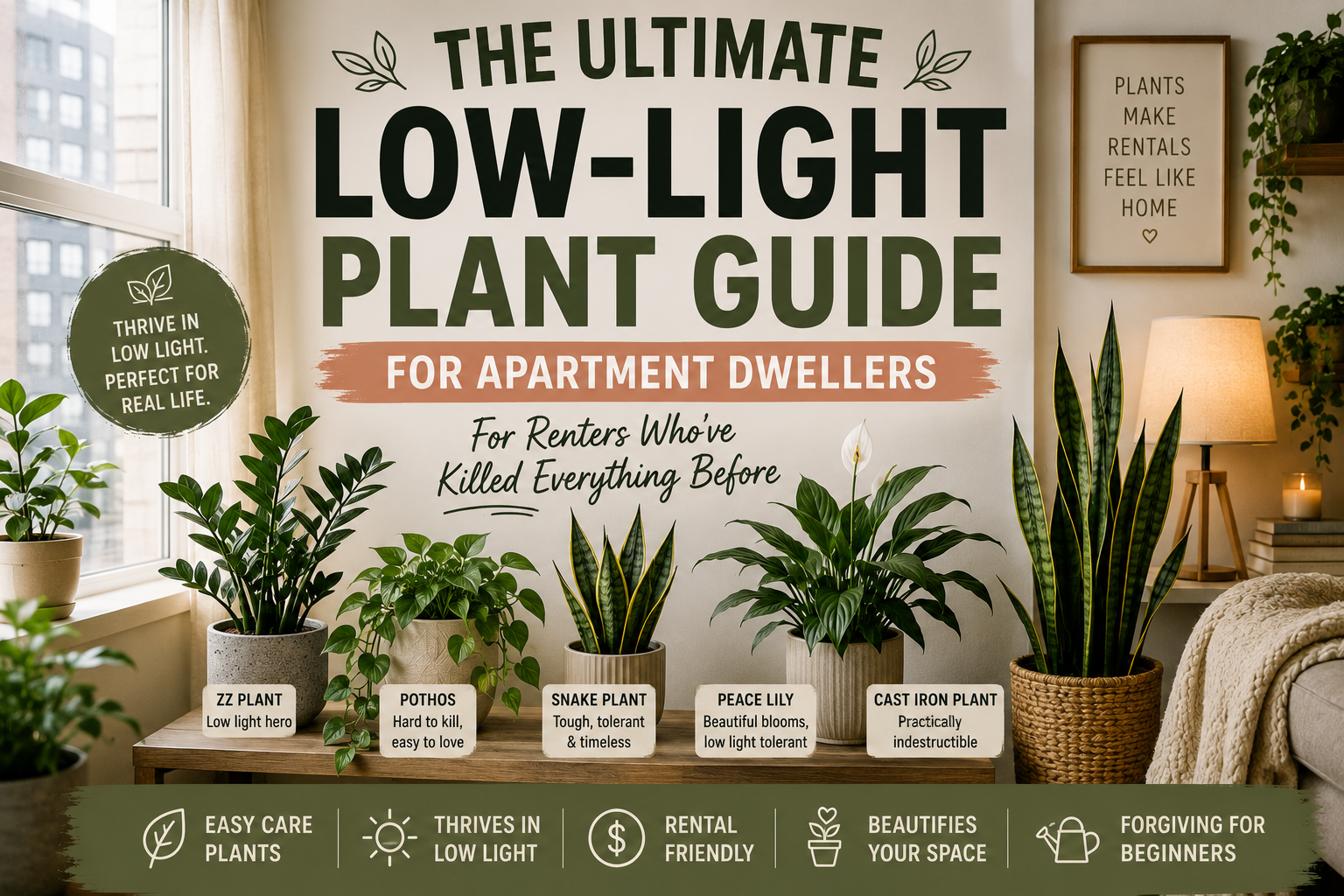
The Ultimate Low-Light Plant Guide for Apartment Dwellers (For Renters Who’ve Killed Everything Before)
This post contains affiliate links. If you buy something through one of them, UrbanBloomSpace may earn a small commission at no extra cost to you — thank you for supporting the site.
I want to start by admitting something: I have killed a lot of plants. Not a couple. A genuinely embarrassing number, spread across three apartments, all of them facing north, all of them getting roughly the light equivalent of a cave with a small window in it.
For years I assumed I just “didn’t have a green thumb.” Then someone finally told me the actual problem: I kept buying plants that needed bright, direct sun, and putting them in an apartment that got maybe two hours of soft, indirect light a day. It wasn’t me. It was a mismatch between the plant and the apartment.
Once I started choosing plants suited to low light instead of fighting my apartment’s actual conditions, everything changed. My “plant graveyard” windowsill became the thing people compliment when they visit. This guide is everything I wish someone had told me before I bought my fifth doomed fiddle leaf fig — real plants that survive low light, real product recommendations, and a realistic budget breakdown so you’re not guessing at the garden center.
If your apartment struggles with light in general, our Renter-Friendly Wall Decor Without Drilling post has some ideas for brightening a space beyond just plants, too. For more picks specifically suited to dim rooms, our roundup of low-light indoor plants is a good companion to this guide.
How to Actually Tell What “Low Light” Means in Your Apartment
Before any plant recommendations, it’s worth ten seconds figuring out what you’re actually working with, because “low light” gets thrown around too loosely.
- Bright indirect light: Near a window, but not in direct sun — you can read comfortably without a lamp on.
- Low light: A few feet back from a window, or a north-facing window with limited direct sun at any point in the day.
- Very low light: Interior rooms, hallways, or windows blocked by buildings — the kind of light where you’d normally always have a lamp on.
Most apartments — especially anything facing north, anything with small windows, or anything with a building blocking the view — fall into the “low” to “very low” categories. That’s normal. It’s also exactly what this list is built for.
The Plants That Actually Survive (Tested, Not Theoretical)
Every plant on this list qualifies as genuinely reliable low-light indoor plants — tested in real apartments, not just theoretically tolerant of shade on a plant tag.
1. Pothos
If you’ve killed everything else, start here. Pothos is genuinely difficult to kill, tolerates low light better than almost any houseplant, and its trailing vines look intentional on a shelf, in a hanging planter, or draped along the top of a bookshelf.
Care level: Beginner. Water when the top inch of soil is dry — usually every 1–2 weeks.
A 6-inch pothos in a ceramic pot ($18–$24) is one of the lowest-risk plant purchases you can make as a beginner.
2. Snake Plant (Sansevieria)
Snake plants tolerate low light, irregular watering, and general neglect better than almost any plant sold at a typical garden center — which makes them close to ideal for apartment dwellers who travel or forget things (no judgment, we’ve all been there).
Care level: Beginner. Water every 2–3 weeks, less in winter.
3. ZZ Plant
Glossy, architectural leaves that look deliberately styled with almost no effort. ZZ plants tolerate very low light and irregular watering, making them one of the few plants that genuinely thrives in an interior room with no direct window access at all.
Care level: Beginner. Water every 2–3 weeks.
4. Peace Lily
Unlike most low-light plants, the peace lily actually tells you when it’s thirsty — the leaves droop noticeably, then perk back up within hours of watering. For beginners nervous about guessing, that visual feedback is genuinely reassuring.
Care level: Beginner–intermediate. Water when leaves start to droop slightly.
5. Cast Iron Plant (Aspidistra)
True to its name, this one is nearly indestructible — it tolerates low light, temperature swings, and inconsistent watering better than almost anything on this list, which is exactly why it was a Victorian-era favorite for dim parlors long before “low light houseplant” was a search term.
Care level: Beginner. Very forgiving of missed waterings.
6. Chinese Evergreen (Aglaonema)
Comes in varieties with silver, pink, or deep green patterned leaves, adding visual interest without needing bright light to look good — a nice option if you want something a little more decorative than solid green.
Care level: Beginner–intermediate. Water every 1–2 weeks.
7. Philodendron (Heartleaf variety)
Similar care needs to pothos, with slightly softer, heart-shaped leaves. Great trailing option for a shelf or hanging planter in a room with limited window access.
Care level: Beginner. Water when top inch of soil is dry.
Plant comparison at a glance:
|
Plant |
Light Tolerance |
Watering Frequency |
Beginner-Friendly? |
|
Pothos |
Low to very low |
1–2 weeks |
Yes |
|
Snake Plant |
Low to very low |
2–3 weeks |
Yes |
|
ZZ Plant |
Very low |
2–3 weeks |
Yes |
|
Peace Lily |
Low |
Weekly, or when drooping |
Yes |
|
Cast Iron Plant |
Very low |
2–3 weeks |
Yes |
|
Chinese Evergreen |
Low |
1–2 weeks |
Moderate |
|
Philodendron |
Low |
1 week |
Yes |
What I Actually Changed (Before and After)
The Before
A north-facing living room with one small window, three dead plants in the past two years, and a general assumption that plants “just weren’t for me.”
The Fix
I replaced everything with a pothos on a bookshelf, a snake plant in the corner that gets almost no direct light at all, and a ZZ plant on a side table near — not directly in front of — my only window.
The After
Eight months later, all three are not just alive but visibly bigger than when I bought them. The room reads as considerably more “finished” with actual living greenery in it, and — genuinely surprising to me — I’ve started to enjoy the small ritual of checking on them each week.
Pots, Planters, and the Gear That Actually Helps
8. Choose pots with drainage, even if it means adding a saucer
The single most common reason low-light plants fail isn’t light — it’s overwatering, made worse by pots with no drainage holes. A terracotta pot with drainage and saucer ($10–$15) does more to keep a plant alive than almost any other single choice.
9. A moisture meter, if you’re anxious about watering
For anyone (me) who has a habit of either forgetting to water entirely or overcompensating with too much, a simple soil moisture meter ($9–$12) removes the guesswork completely — stick it in the soil, and it tells you if it’s actually time to water or not.
10. A small grow light for the darkest corners
If you have a genuinely windowless spot you still want to put a plant in, a small clip-on grow light ($20–$28) can supplement natural light enough to keep even low-light plants healthy in spaces with almost no window access at all.
11. Hanging planters for vertical space
If floor and shelf space are limited, a macrame or ceramic hanging planter ($15–$22) lets you use ceiling and wall height instead of competing for surface space — especially good for trailing plants like pothos or philodendron.
12. Self-watering pots for frequent travelers
If you’re often away for a week or more, a self-watering planter insert ($14–$18) can be the difference between coming home to a thriving plant or a crispy one.
Gear budget breakdown:
|
Item |
Cost |
Solves |
|
Drainage pot + saucer |
$10–$15 |
Overwatering, root rot |
|
Moisture meter |
$9–$12 |
Watering guesswork |
|
Clip-on grow light |
$20–$28 |
Windowless rooms |
|
Hanging planter |
$15–$22 |
Limited surface space |
|
Self-watering insert |
$14–$18 |
Frequent travel |
A Realistic Starter Budget
|
Tier |
What’s Included |
Total Cost |
|
Under $25 |
One pothos or snake plant, basic terracotta pot |
~$22 |
|
Under $60 |
Two plants, drainage pots, moisture meter |
~$55 |
|
Under $100 |
Three plants, pots, moisture meter, one hanging planter |
~$95 |
|
Full low-light setup |
Above plus a clip-on grow light for a darker room |
~$120 |
You don’t need all seven plants at once. Start with one — pothos or snake plant, both genuinely hard to fail with — and build from there once you’ve got a feel for your space’s actual light and your own watering habits.
Free Printable: Low-Light Plant Care Tracker
If you want a simple way to track watering schedules without relying on memory (or a moisture meter every time), grab the free Low-Light Plant Care Tracker — download it here. It’s a printable chart for up to six plants, built around the watering frequencies in this guide.
If you’re setting up a whole apartment and want plants incorporated into the bigger picture, our Apartment Setup Starter Kit digital bundle includes a room-by-room styling planner that factors in light and layout together.
Frequently Asked Questions
What’s the easiest low-light houseplant for beginners? Pothos and snake plants are the most forgiving options — both tolerate low light, inconsistent watering, and general beginner mistakes better than almost any other common houseplant.
Can plants survive in an apartment with no direct sunlight at all? Yes — snake plants, ZZ plants, and cast iron plants are specifically suited to very low light conditions and can survive in interior rooms or spaces with minimal window access, especially with an occasional boost from a small clip-on grow light.
How often should I water low-light plants? Most low-light plants need less frequent watering than sun-loving plants — generally every 1–3 weeks depending on the plant, watering only once the top inch or more of soil has fully dried out.
Do low-light plants need a grow light? Not necessarily. Most on this list can survive on ambient indirect light alone. A grow light becomes useful specifically for windowless rooms or very dark corners where even low-light plants would otherwise struggle.
Final Thought
I spent years assuming I was bad at keeping plants alive. I wasn’t — I was buying the wrong plants for the light I actually had. Once that mismatch got fixed, keeping plants alive stopped being a struggle and started being one of the more genuinely enjoyable parts of my apartment.
Start with one pothos. Put it somewhere with a little indirect light, water it when the soil’s dry an inch down, and let it prove to you that this is easier than you think.
Save this for later, and check out more budget-friendly apartment guides on UrbanBloomSpace — we’re building this library one small space at a time. And if you want to browse even more low-light indoor plants before you shop, that roundup is a great next stop.