
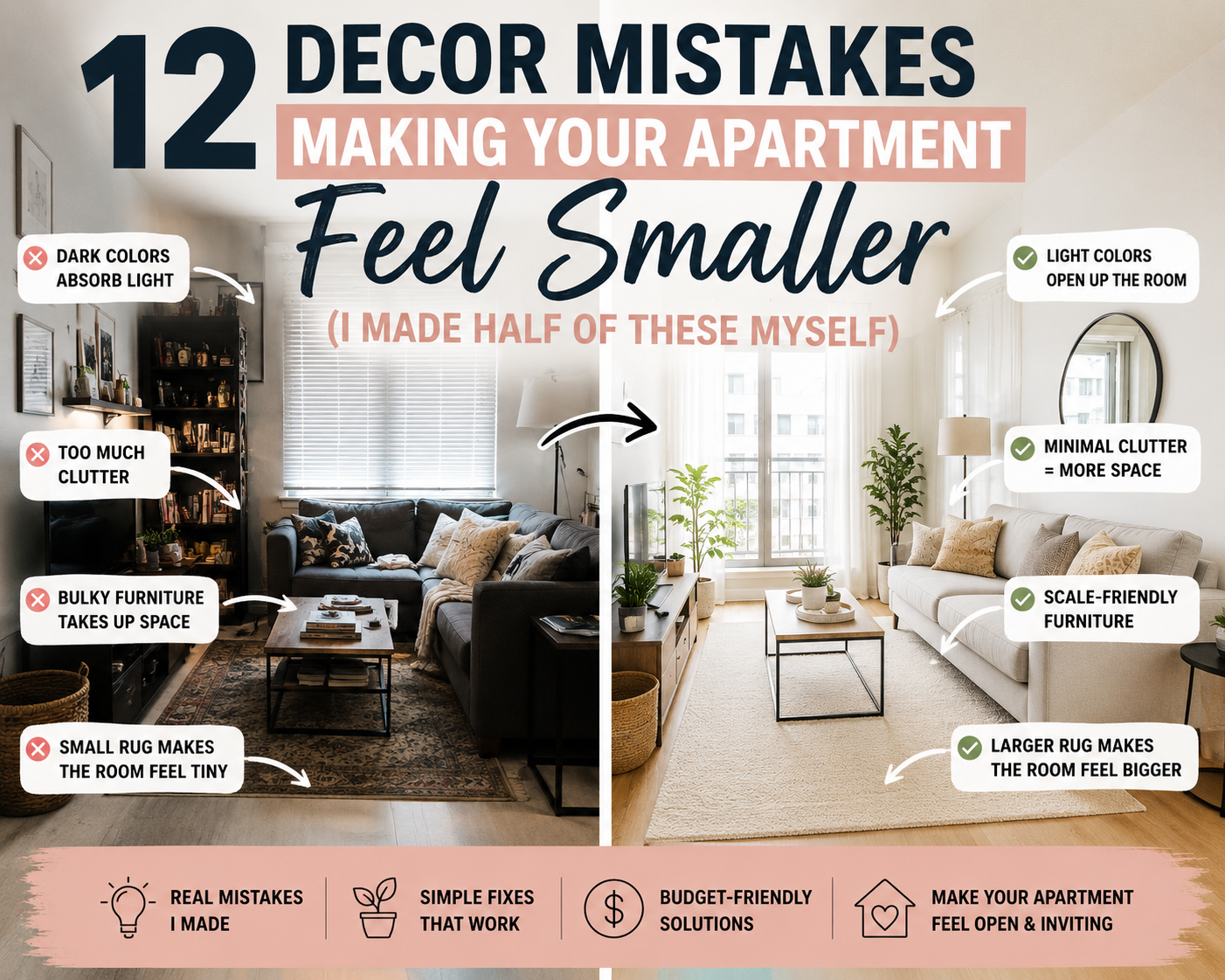
12 Decor Mistakes Making Your Apartment Feel Smaller (I Made Half of These Myself)
This post contains affiliate links. If you buy something through one of them, UrbanBloomSpace may earn a small commission at no extra cost to you — thank you for supporting the site.
For the first year in my apartment, I genuinely thought I just had bad luck with square footage. My living room felt cramped no matter how I arranged the couch. My bedroom felt like a hallway with a bed in it. I kept telling myself the fix was moving — a bigger place, more money, someday.
Then a friend who works in interior styling came over, looked around for about ninety seconds, and said, “Your apartment isn’t small. Your decor is just fighting the room.” She was right, and it was slightly annoying to hear.
It turns out most of what makes a small apartment feel smaller than it is has nothing to do with square footage and everything to do with a handful of common, completely fixable decor habits — several of which I was doing in every single room. Below are the 12 mistakes I see most often (and made most often myself), plus what to do instead, most of it for very little money.
If you’re just starting to furnish a small space, our Small Apartment Layout Guide for Beginners pairs well with this list before you buy anything new — and for more small apartment decor ideas, our plant care library is worth bookmarking too.
Why This Matters More Than People Think
Small space design isn’t really about fitting more stuff into less room. It’s about visual flow — how quickly your eye can move through a space without getting stopped, blocked, or confused. Every mistake on this list interrupts that flow in some way, which is why fixing them tends to make a room feel noticeably bigger without removing a single piece of furniture.
Mistake #1: Pushing All Your Furniture Against the Walls
The Problem
This is the single most common small-space instinct, and it’s almost always backwards. Lining every piece against the wall leaves a big, awkward dead zone in the middle of the room that reads as empty and makes the perimeter feel cramped at the same time.
The Fix
Pull your couch even six to eight inches off the wall and angle it slightly toward the room’s natural focal point — a window, a TV, a fireplace. A slim console table ($45–$60) behind the couch fills that gap and adds function instead of leaving dead space.
Before/after: My living room felt genuinely 20% larger just from pulling my couch off the wall and adding one round rug underneath it to anchor the seating area.
Mistake #2: Choosing Furniture That’s Too Big for the Room
The Problem
Oversized furniture is one of the fastest ways to shrink a room visually, even if it’s technically comfortable. A deep, heavy sectional in a small living room doesn’t just take up floor space — it visually dominates the entire room.
The Fix
Look for furniture with exposed legs rather than skirted bases — a few inches of visible floor underneath a couch or chair lets light travel under it, which reads as more open space even though the furniture itself hasn’t changed size.
Mistake #3: Skipping Vertical Space Entirely
The Problem
Most small apartments only get decorated from waist-height down. Walls stay bare above eye level, which makes ceilings feel lower and rooms feel more boxed-in than they are.
The Fix
Tall, narrow bookshelves ($70–$90) that go floor-to-ceiling draw the eye upward and make use of a room’s actual height, not just its floor space. Even a single tall shelf in one corner changes how a whole room reads.
For more no-damage ways to use wall height in a rental, see our Renter-Friendly Wall Decor Without Drilling guide.
Mistake #4: Too Many Small, Scattered Accent Pieces
The Problem
A dozen tiny decor items spread across every surface creates visual noise. Your eye doesn’t know where to land, and a busy room reads as smaller than a calmer one — even at the exact same size.
The Fix
Group items in odd numbers (threes work best) on a single tray or shelf rather than scattering them across multiple surfaces. A simple wooden tray ($15–$20) corrals small items into one visual “zone,” giving the rest of the surface breathing room.
Before/after: I had candles, coasters, a plant, and a stack of books spread across my coffee table individually. Grouped onto one tray, the same items read as styled instead of cluttered — same objects, completely different feeling.
Mistake #5: Heavy, Dark Curtains on Small Windows
The Problem
Thick, dark curtains — especially ones that don’t reach the floor — visually shrink both the window and the wall around it, cutting off natural light in a room that’s already working with limited square footage.
The Fix
Sheer or light linen-look curtains ($30–$40) hung close to the ceiling rather than directly above the window frame make windows look taller and let more light spread through the room, which is one of the fastest tricks for making any space feel bigger.
Mistake #6: One Small Rug Floating in the Middle of the Room
The Problem
A rug too small for your furniture arrangement — with chairs or a couch sitting entirely off of it — visually chops the floor into disconnected sections instead of one cohesive space.
The Fix
Size up. At minimum, the front legs of your seating should sit on the rug. A larger area rug ($60–$90) that unifies the whole seating area does more for a room’s sense of scale than almost any other single change on this list.
Rug sizing comparison:
|
Rug Placement |
Visual Effect |
|
Small rug, furniture entirely off it |
Chops the room into pieces |
|
Rug under front legs only |
Connects the space, budget-friendly |
|
Rug under all furniture legs |
Most cohesive, best for larger budgets |
Mistake #7: Too Many Small, Busy Patterns
The Problem
Small-scale, high-contrast patterns repeated across pillows, rugs, and curtains create visual chaos that makes a small room feel even more compressed.
The Fix
Stick to one patterned “hero” piece per room, and let everything else lean solid or subtly textured. A solid-color textured throw ($25–$30) does more visual calming work than another patterned pillow ever will.
Mistake #8: Matching Everything Too Perfectly
The Problem
This one surprises people: a room where every piece matches exactly in tone and finish can actually feel flatter and smaller than one with some variation, because there’s no depth for the eye to read.
The Fix
Mix in at least one different wood tone, metal finish, or texture per room. It doesn’t need to be dramatic — a matte black accent lamp ($25–$35) next to warmer wood tones adds just enough contrast to create depth.
Mistake #9: No Mirrors Anywhere
The Problem
This is the most well-known small-space trick for a reason — and also the most commonly skipped, usually because people assume a “real” mirror installation is expensive or complicated in a rental. It’s one of those small apartment decor ideas that sounds too simple to actually work, until you try it.
The Fix
A large leaning floor mirror ($70–$90) placed to reflect a window or a light source requires zero mounting and instantly doubles the sense of light and depth in a room. This is consistently the single highest-impact item on this entire list.
Before/after: Adding one leaning mirror across from my living room window was the closest thing to an instant fix I found in two years of apartment tweaks.
Mistake #10: Overhead Lighting as Your Only Light Source
The Problem
A single bright overhead light flattens a room and makes corners and edges disappear into shadow, which paradoxically makes a small space feel like it has even less usable area.
The Fix
Add at least one lower-level light source — a small table or floor lamp ($30–$40) — so light is layered at different heights. Corners stop disappearing, and the room reads as having more usable space than it did under one flat overhead light.
For more on this specific fix, our Cozy Apartment Ideas Under $100 post goes deeper into lighting layering room by room.
Mistake #11: Storage That’s Fully Open and Visible
The Problem
Open shelving looks great in photos, but fully exposed storage — especially anything mismatched or overflowing — reads as visual clutter that makes a small room feel more crowded than closed storage would.
The Fix
Swap at least some open storage for woven or fabric bins with lids ($15–$20 each) that hide contents while keeping the shape and structure of open shelving. You get the storage without the visual noise.
Storage comparison:
|
Storage Type |
Visual Effect |
Cost |
|
Fully open, mismatched items |
Reads as cluttered |
$0 (already own) |
|
Open shelving + matching bins |
Calm, structured |
$15–$40 |
|
Fully closed cabinets |
Cleanest look, least accessible |
Varies |
Mistake #12: No Clear Focal Point in the Room
The Problem
Without one clear thing to draw the eye — a piece of art, a bed, a window — a room’s furniture arrangement can feel directionless, and directionless rooms tend to feel smaller because there’s nowhere for the eye to settle.
The Fix
Choose one focal point per room and arrange everything else around it. A single larger framed print ($35–$45) above the couch or bed, hung with command strip picture hangers ($8) for a damage-free install, gives the whole room a clear anchor point instead of competing directions.
The Full Fix List, Ranked by Cost
|
Fix |
Cost |
Priority |
|
Pull furniture off the wall |
$0 |
Do this first |
|
Group small decor onto a tray |
$15–$20 |
Immediate |
|
Add a leaning mirror |
$70–$90 |
Highest impact for the price |
|
Size up your area rug |
$60–$90 |
High impact |
|
Layer in a second light source |
$30–$40 |
High impact |
|
Swap open storage for lidded bins |
$15–$40 |
Medium |
|
Choose one focal point + art piece |
$35–$45 |
Medium |
Free Printable: Small Space Decor Audit
Want to walk through your own apartment room by room and catch these mistakes yourself? Grab the free Small Space Decor Audit Checklist — download it here — it turns this whole list into a walkthrough you can do in about fifteen minutes per room.
If you’re furnishing a space from scratch and want to avoid these mistakes entirely, our Apartment Setup Starter Kit digital bundle includes a layout planner built around exactly this kind of small-space visual flow.
Frequently Asked Questions
What’s the biggest decor mistake that makes small apartments look smaller? Pushing all furniture flush against the walls is the most common and most impactful mistake — it leaves an awkward empty center and makes the room’s edges feel cramped at the same time.
Do mirrors actually make small apartments feel bigger? Yes — a large leaning mirror placed to reflect a window or light source is consistently one of the highest-impact, lowest-effort changes for making a small room feel more open, without any mounting required.
Should I use a small rug or a big rug in a small living room? Size up. A rug that only fits under the front legs of your furniture unifies the space; a too-small rug floating in the middle chops the room into disconnected sections and makes it feel smaller.
Does clutter actually make a room feel smaller, or is that just aesthetic preference? It’s more than aesthetic — visually busy surfaces and scattered small items force your eye to stop repeatedly rather than move smoothly through the space, which is part of why cluttered rooms read as more cramped even at the same square footage.
Final Thought
I spent a year assuming my apartment’s size was the problem. It wasn’t. It was a dozen small, fixable habits — furniture pushed to the walls, no mirror, one overhead light, decor scattered instead of grouped — all working against the room at the same time.
Start with the free fix: pull your couch a few inches off the wall tonight and see what happens. It’s a small thing that tends to prove the whole point almost immediately.
Save this for later, and check out more small-space apartment guides on UrbanBloomSpace — we’re building this library one square foot at a time. Still hunting for small apartment decor ideas? Our plant care guides are a good next stop.