
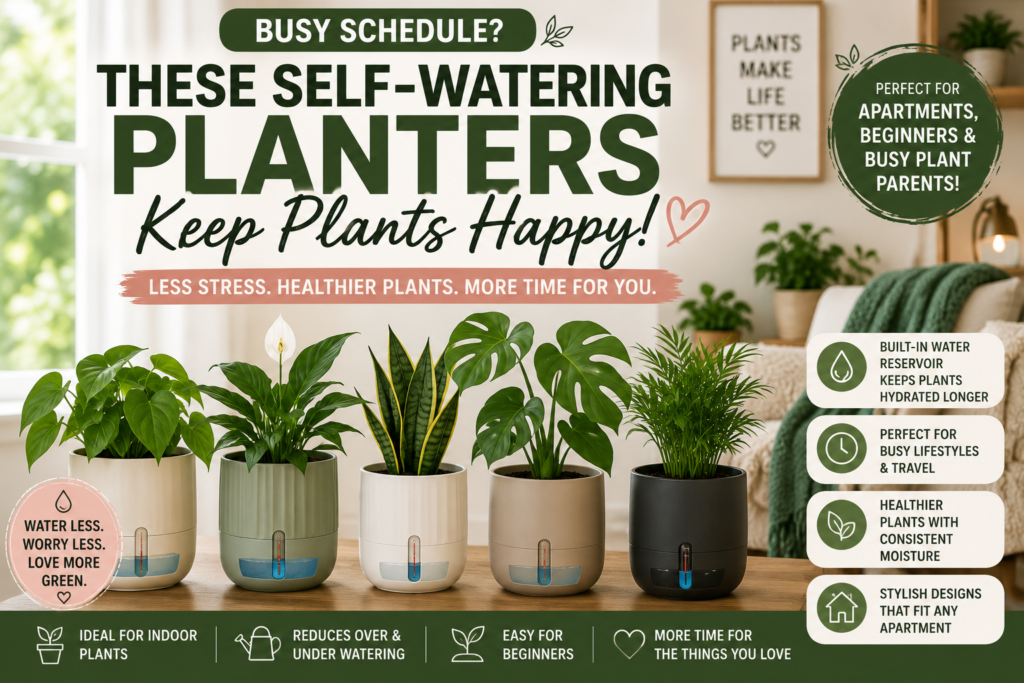
Busy Schedule? These Self-Watering Planters Keep Plants Happy
This post contains affiliate links. If you buy something through one of them, UrbanBloomSpace may earn a small commission at no extra cost to you — thank you for supporting the site.
Somewhere around plant death number four, I stopped blaming my apartment’s light and started being honest with myself about the actual problem: I am not a consistent waterer. Some weeks I’d water religiously, twice even, out of guilt. Other weeks — usually the busy ones, or the ones where I traveled for work — a plant would go two and a half weeks without a drop, and I’d come home to something crispy and unsalvageable.
It wasn’t a light problem or a plant-choice problem at that point. It was a me problem, and I say that with zero shame, because it turns out this is an extremely common one. When I finally looked into self-watering planters, I expected some kind of complicated irrigation system. What I found instead were simple, often genuinely nice-looking pots with a built-in water reservoir — no plumbing, no tech, just a smarter container doing a chunk of the work I kept forgetting to do.
This guide covers what actually works, what to look for, and specific picks depending on whether you’re a frequent traveler, a genuine beginner, or just someone with a busy enough schedule that “water on Tuesdays” quietly stopped happening months ago. If you’re also dealing with a low-light space on top of an inconsistent watering schedule, our Ultimate Low-Light Plant Guide for Apartment Dwellers and grow light guide pair well with this one.
How Self-Watering Planters Actually Work (No, It’s Not Magic)
Most self-watering planters use the same basic design: an inner pot holding the plant and soil sits above a separate water reservoir in the base. A wicking mechanism — usually a cord, a fabric strip, or a simple capillary tube — draws water up from the reservoir into the soil as the plant needs it, rather than all at once.
The practical result: instead of a feast-or-famine cycle of forgetting to water and then overcompensating, the plant pulls a steady, moderate amount of moisture on its own schedule. Most reservoirs last anywhere from one to three weeks depending on the plant, pot size, and season, which is exactly why this category has become one of the most searched solutions for self-watering planters that prevent overwatering — the wicking system genuinely limits how much water reaches the roots at once, unlike a watering can where it’s easy to drown a plant without realizing it.
Best Self-Watering Planters for Indoor Plants and Houseplants
Not every self-watering pot is built the same way, and picking the right one depends more on your plant type than people expect. Here’s how the main categories break down:
1. Wick-System Ceramic Planters
A glazed ceramic self-watering planter ($22–$32) is the most common style for standard houseplants like pothos, philodendron, or peace lilies. The reservoir sits in a hidden base, and a small water-level indicator on the outside tells you when it’s time to refill — genuinely useful if, like me, you’d otherwise never think to check.
2. Plastic Insert Systems (For Existing Pots)
If you already own planters you like, a self-watering insert liner ($12–$18) can be dropped into most existing pots to add reservoir function without replacing the pot itself. This is the cheapest entry point into this whole category by a fair margin.
3. Modern Self-Watering Planters for Apartments
This is where the category has genuinely improved in the last couple of years. A matte ceramic self-watering planter in a minimalist shape ($28–$40) looks like a standard design-forward pot — no visible tubing, no obvious “plant gadget” aesthetic — which matters if you want function without your shelf looking like a garden supply store.
4. Terracotta-Style Self-Watering Pots
For anyone who prefers a warmer, more textured look over sleek ceramic, terracotta-finish self-watering pots ($20–$30) offer the same wicking function in a more traditional, earthy style.
Comparison at a glance:
Type | Cost | Best For | Style |
Wick-system ceramic | $22–$32 | Standard houseplants | Classic |
Insert liner (for existing pots) | $12–$18 | Budget-conscious, reusing pots | Depends on pot |
Modern minimalist ceramic | $28–$40 | Design-focused apartments | Sleek |
Terracotta-style | $20–$30 | Warmer, textured spaces | Earthy |
Self-Watering Planters for Busy People and Frequent Travelers
If you’re specifically dealing with a schedule that makes weekly watering unrealistic — regular work travel, long hours, unpredictable weeks — this is genuinely the plant category built for you.
Most self-watering planters for people who travel hold enough reserve water to comfortably cover 10–14 days without attention, and some larger reservoir models stretch closer to three weeks depending on the plant and season. That’s long enough to cover most work trips without asking a neighbor to come water your plants, and long enough that a normal busy week simply doesn’t register as a crisis anymore.
Before/after: I used to text a neighbor before every trip longer than four days, plant-sitting instructions and all. After switching my three most finicky plants to self-watering pots, that text hasn’t gone out once in the past year, even for a two-week trip.
Self-Watering Planters for Beginners and Forgetful Plant Owners
If you’re newer to keeping plants alive at all, self-watering planters solve the single most common beginner mistake: inconsistent watering, usually swinging between forgetting entirely and then panic-overwatering to compensate.
For self-watering planters for forgetful plant owners specifically, look for models with a visible water-level window — a small strip on the outside of the pot that shows at a glance whether the reservoir needs a refill, without requiring you to remember a schedule at all. This single feature is worth prioritizing over style or price if forgetfulness (not travel) is your main issue.
A starter self-watering planter with a water-level indicator ($18–$25), paired with a genuinely forgiving plant like a pothos or peace lily, is close to the lowest-effort way to keep a houseplant alive that exists right now.
Self-Watering Herb Planters (For Actually Using What You Grow)
Herbs are a slightly different case, since they’re watered more frequently than most houseplants and are usually kept in a kitchen where forgetting to water is even more common — you’re focused on cooking, not plant care, in that moment.
A self-watering herb planter set ($25–$35), often sized for a windowsill and holding two to three herbs, keeps basil, mint, or parsley consistently moist without daily watering. This is one of the more genuinely useful entries in the entire self-watering category, since herbs punish inconsistent watering (wilting, bolting, bitter leaves) faster and more visibly than most houseplants do.
Apartment-Friendly Self-Watering Pots: What to Check Before Buying
Not every self-watering planter is a great fit for apartment living specifically. A few things worth checking:
- Overflow protection. Look for a small overflow hole in the reservoir so an accidental overfill drains instead of flooding your windowsill or shelf.
- Size relative to your space. Larger reservoir models hold water longer but take up noticeably more surface area — worth measuring your shelf or sill before buying if space is tight.
- Material weight. Ceramic self-watering pots are heavier than plastic insert versions, which matters if you’re placing them on wall-mounted shelving with a weight limit.
A self-watering planter with a built-in overflow drain ($24–$34) is worth the slightly higher price if you’re placing pots on wood shelving or near electronics, simply for the peace of mind.
The Full Budget Breakdown
Tier | What’s Included | Total Cost |
Cheapest entry point | One insert liner for an existing pot | ~$15 |
Under $30 | One standard wick-system ceramic planter | ~$25 |
Under $50 | One modern ceramic planter + one insert liner | ~$45 |
Full small collection | Three planters mixing ceramic, terracotta, and one herb set | ~$85–$100 |
You don’t need to convert every plant at once. Start with whichever plant has died the most times, or whichever one you travel away from most often — that’s usually where self-watering makes the most noticeable difference, fastest.
Free Printable: Self-Watering Refill Tracker
Even self-watering planters need occasional refilling — usually every 1–3 weeks depending on the model and season. Grab the free Self-Watering Refill Tracker — download it here — a simple printable to log refill dates across a small plant collection so you’re not guessing at reservoir levels from memory.
If you’re building out your plant setup from scratch, our Ultimate Low-Light Plant Guide and grow light guide round out the rest of what you’ll need for a low-effort, low-light apartment plant collection.
Frequently Asked Questions
What are the best self-watering planters for indoor plants? Ceramic wick-system planters are the most reliable all-purpose option for common houseplants like pothos, philodendron, and peace lilies, typically holding enough water to last one to two weeks between refills.
Do self-watering planters actually prevent overwatering? Yes — the wicking system draws water gradually from the reservoir into the soil as needed, rather than saturating it all at once the way manual watering with a watering can often does, which is the main reason this category is associated with preventing overwatering specifically.
Are self-watering planters good for beginners? Yes, especially models with a visible water-level indicator, since they remove the guesswork of figuring out when to water — one of the most common reasons beginner houseplants struggle in the first place.
How long can a self-watering planter go without a refill? Most standard-sized self-watering planters last 10–14 days between refills, with larger reservoir models stretching closer to three weeks depending on the plant type and season.
Are self-watering planters apartment-friendly? Yes — most models require no installation, plumbing, or electricity, and design-forward ceramic options are built specifically to fit apartment aesthetics rather than looking like gardening equipment.
Final Thought
I used to think I just wasn’t cut out for keeping plants alive. What I actually needed was a container that could handle the gap between my intentions and my actual weekly follow-through — which, it turns out, is a pretty normal gap to have.
Start with your one plant that’s died the most times. A $20–25 self-watering pot might be the actual fix you’ve been looking for, not another plant-care resolution you’re unlikely to keep.
Save this for later, and check out more budget-friendly apartment guides on UrbanBloomSpace — we’re building this library one small space at a time.