
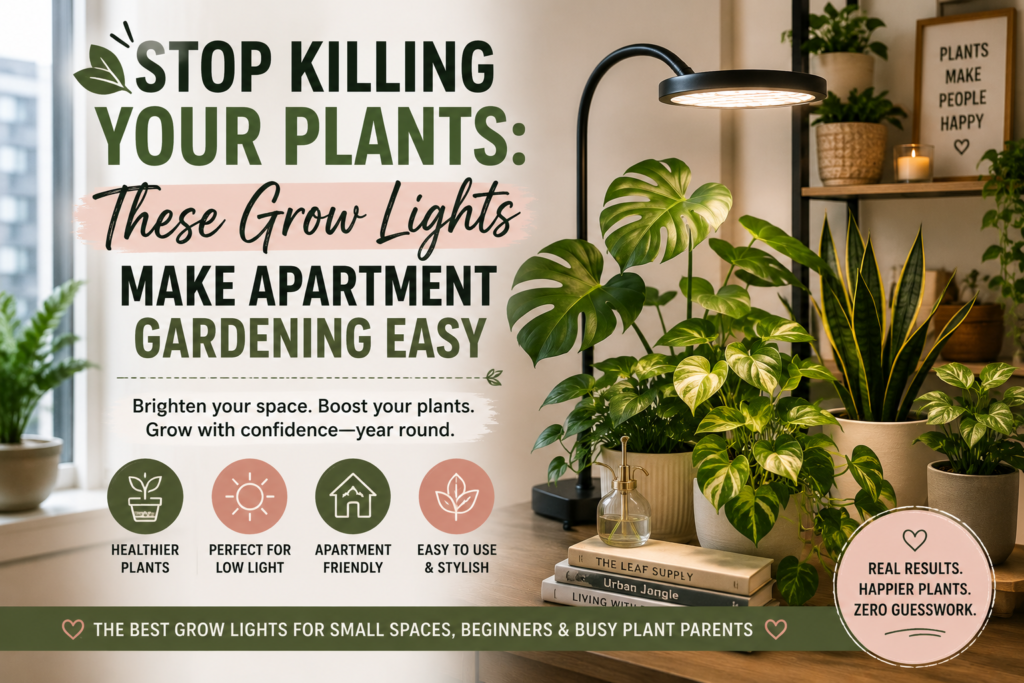
This post contains affiliate links. If you buy something through one of them, UrbanBloomSpace may earn a small commission at no extra cost to you — thank you for supporting the site.
I wrote an entire guide a few months back about the low-light plants that finally stopped dying in my apartment — pothos, snake plants, ZZ plants, the usual reliable suspects. And they did survive. But “surviving” and “thriving” turned out to be two very different things.
My pothos held on for months without growing a single new leaf. My snake plant just… existed, the same size in June as it was in January. It wasn’t until a friend pointed out that my apartment’s north-facing windows were giving my plants basically none of the light they needed — not zero, but not enough to actually grow — that I looked into grow lights for the first time. And I’ll admit, I put it off for a while, because every grow light I’d ever seen in my head looked like something out of a basement hydroponics setup. Purple glow, ugly clamps, definitely not something I wanted sitting on my living room shelf.
That assumption turned out to be badly outdated. The grow light market has quietly gotten a lot more apartment-friendly — a lot more stylish grow lights for apartments now exist that look like normal lamps, not lab equipment. This guide covers what actually works, what to look for, and specific picks depending on your space, your budget, and how dark your apartment actually is.
If you haven’t already, our Ultimate Low-Light Plant Guide for Apartment Dwellers is a good companion to this post — pair the right plant with the right light, and you’ll get a lot further than either one alone.
Do You Actually Need a Grow Light?
Before spending anything, it’s worth figuring out if this is really your problem. A few signs your plants are light-starved rather than just “resting”:
- New growth is small, pale, or leggy (long stretches of stem with leaves far apart)
- Leaves are turning toward the window and nothing else looks healthy
- You’ve had the same plant for six+ months with zero visible growth
- Your apartment gets less than 2–3 hours of indirect natural light a day
If two or more of those sound familiar, you’re looking at the right solution. This is especially common for renters searching for grow lights for dark apartments — north-facing units, apartments with small windows, or units with a building blocking most of the natural light.
What Actually Matters When Choosing a Grow Light
Skip the jargon overload — here’s what genuinely matters for apartment use:
Full-spectrum LED. This mimics natural daylight rather than the harsh purple/pink glow older grow lights are known for. It’s the single biggest reason grow lights have become livable in normal rooms instead of looking like a science project.
Adjustable brightness or timer function. You don’t want to think about turning a light on and off every day — a built-in timer is worth paying slightly more for.
Design that fits your space. This is where the category has changed the most. You’re no longer choosing between “ugly and functional” and “pretty and useless” — there are genuinely good options in both the decorative grow lights for indoor plants category and the more clinical, high-output category, depending on what you need.
The Best Grow Lights for Small Spaces (By Type)
1. Clip-On Grow Lights
The most flexible option for small apartments, because they attach directly to a shelf, headboard, or desk edge without needing their own footprint. A clip-on full-spectrum LED grow light ($22–$30) is usually the first thing I’d recommend to someone with just one or two plants and limited surface space.
Best for: Small collections, desks, shelves, bedside plants.
2. Grow Light Floor Lamps
These are the biggest shift in this category over the past couple of years — floor lamp-style grow lights that look like ordinary living room lighting, not equipment. A grow light floor lamp with a fabric shade ($55–$75) can sit next to a reading chair and double as ambient lighting in the evening, while still delivering plant-usable light during the day.
Best for: Larger plants, statement pieces, anyone who wants the light itself to look intentional.
3. Desktop/Tabletop Grow Lamps
A smaller-scale version of the floor lamp, styled more like a modern desk lamp than a plant tool. A tabletop grow lamp with a wood or matte metal base ($35–$45) works well on a console table, bookshelf, or windowsill where a full floor lamp would be too much.
Best for: Single statement plants, entryway tables, small apartments overall.
4. Grow Light Bulbs (For Existing Fixtures)
If you already own a lamp you like, a simple full-spectrum grow light bulb ($12–$18) that fits a standard socket is the cheapest possible entry point — no new fixture required at all.
Best for: Budget-conscious setups, renters who don’t want to buy new furniture.
5. Hanging/Pendant Grow Lights
For apartments using vertical space with hanging planters, a small pendant-style grow light ($40–$60) can be mounted with a tension rod or ceiling hook (renter-safe options exist for both) to light trailing plants from above.
Best for: Hanging plants, macrame planters, apartments tight on floor and shelf space.
Grow light type comparison:
| Type | Cost Range | Best For | Style Level |
| Clip-on | $22–$30 | Shelves, desks, small plants | Functional |
| Floor lamp style | $55–$75 | Statement plants, living rooms | High |
| Tabletop/desk style | $35–$45 | Consoles, entryways, bookshelves | High |
| Bulb only | $12–$18 | Existing lamps, tightest budgets | Depends on fixture |
| Hanging/pendant | $40–$60 | Trailing or hanging plants | Medium–High |
Grow Lights for Renters: What to Know Before You Buy
If you’re specifically searching for grow lights for renters, the good news is that almost nothing on this list requires any permanent installation. Clip-on models attach without hardware, floor and tabletop lamps just need an outlet, and even pendant-style options can be hung with tension rods or removable ceiling hooks rather than anything drilled in.
The one thing worth checking before you buy: cord length and outlet placement. More than one person (myself included) has bought a beautiful grow light lamp only to realize the nearest outlet is four feet further away than the cord reaches. A cheap extension cord with a slim, low-profile design ($10) solves this without an ugly cord running across your floor.
Apartment Grow Lights Under $50: What You Actually Get
This is where most people searching for apartment grow lights under $50 land, and honestly, it’s a very reasonable budget to work with. Here’s what fits:
- A clip-on grow light ($22–$30) — covers one to two plants effectively
- A grow light bulb for an existing lamp ($12–$18) — the cheapest functional option
- A basic tabletop grow lamp on sale or from a budget brand ($35–$45)
What you generally don’t get under $50: coverage for more than two or three plants at once, or the more furniture-like floor lamp styles, which tend to start around $55–$60. If your budget is firmly under $50, prioritize one clip-on light for your neediest plant rather than spreading a cheaper light across your whole collection — concentrated light on one plant works better than diffuse light across five.
Decorative Grow Lights That Don’t Look Like Grow Lights
If the aesthetic is your main hesitation, this category has come a long way. Look specifically for:
- Fabric or paper lamp shades rather than exposed bulb designs
- Warm wood or matte black finishes instead of white plastic housings
- Brands that market to home decor audiences, not just gardening or hydroponics audiences — the design quality tends to be noticeably better
A grow light disguised as a mid-century style floor lamp is a good example of where this category is headed — genuinely difficult to identify as a grow light unless you already know to look for it.
Before and After: What Actually Changed
The Before
My pothos, six months in, on a shelf about eight feet from my only window. Same size as the day I bought it. A few yellowing lower leaves I kept trimming off and blaming on “just how pothos are sometimes.”
The Fix
A single clip-on grow light, attached to the shelf edge, running on a timer for about 10 hours a day.
The After
Within about six weeks, new growth — actual new leaves, bigger than the older ones. It wasn’t dramatic overnight, but it was the first real proof I’d had that the plant wasn’t just “meant to be small.” It was light-starved, and the fix cost $26.
Grow Lights for Apartment Dwellers: A Realistic Starting Setup
If you’re just beginning and don’t want to overthink this, here’s the simplest possible starting point:
- Pick your one plant that’s struggling the most (usually the one furthest from a window)
- Add a single clip-on grow light nearby
- Put it on a timer for 8–10 hours a day
- Wait 4–6 weeks before judging results — plant growth is slow to show, even when it’s working
Once you see results, expand from there — a second clip-on light, or a floor lamp style if you want the next plant to double as a decor piece rather than hiding equipment.
Budget Breakdown
| Tier | What’s Included | Total Cost |
| Absolute minimum | One grow light bulb, existing lamp | ~$15 |
| Under $50 | One clip-on grow light + timer | ~$35–$45 |
| Mid-range | Tabletop grow lamp + timer | ~$50–$65 |
| Full statement setup | Floor lamp style grow light + timer | ~$70–$90 |
Free Printable: Apartment Plant Light Tracker
Pair this guide with the free Low-Light Plant Care Tracker from our plant guide post — it includes a simple space to log which plants are under a grow light and for how long each day, so you’re not relying on memory to track your timer settings across multiple plants.
Frequently Asked Questions
What are the best grow lights for apartments with no natural light? Clip-on full-spectrum LED grow lights are the most effective and flexible option for apartments with very limited natural light, since they can be positioned directly next to the plant that needs it most rather than lighting an entire room.
Are there grow lights that don’t look like grow lights? Yes — floor lamp and tabletop-style grow lights with fabric shades or wood/matte metal finishes are designed to look like standard home lighting, making them a good fit for anyone hesitant about the aesthetic.
Do grow lights work for renters who can’t install permanent fixtures? Yes — clip-on, tabletop, and floor lamp grow lights all work on standard outlets with no installation required, and even hanging styles can typically use tension rods or removable hooks instead of anything drilled in.
How much do apartment-friendly grow lights cost? Functional options start around $12–$18 for a simple grow light bulb for an existing lamp, with more decorative floor lamp or tabletop styles typically running $35–$75 depending on design.
How long should a grow light stay on each day? Most full-spectrum grow lights for houseplants work well on 8–10 hours a day, ideally run on a timer so you’re not manually turning it on and off.
Final Thought
I spent way too long assuming my plants were just naturally slow growers, when the real issue was an apartment that simply didn’t get enough light for them to do more than survive. A single $26 clip-on light changed that faster than I expected — and it didn’t require moving, remodeling, or replacing a single plant I already loved.
If you’ve got one plant that’s been stuck at the same size for months, that’s the one to start with.Save this for later, and check out more budget-friendly apartment guides on UrbanBloomSpace — we’re building this library one small space at a time.